
President Trump’s Port Huron rally put Michigan’s Senate and governor races squarely on a pro-law-and-order, pro-border, and anti-woke ballot — and he told voters exactly which Republicans to elect.
Story Highlights
- Trump campaigned in Port Huron for Senate nominee Mike Rogers and gubernatorial nominee John James.
- Trump framed the Senate race as a high-stakes fight and urged voters to stop Democrat Abdul El-Sayed.
- Thousands attended as Republicans sought late momentum ahead of voting.
- Trump’s team hyped celebrity support to widen reach and energize voters.
Trump Pins Michigan Races To Security, Borders, And Economy
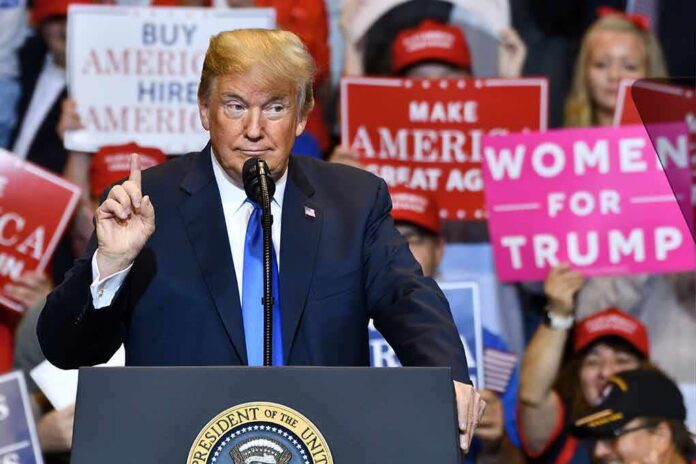
President Trump headlined a Port Huron rally on October 25, urging Michigan voters to elect Republican Senate candidate Mike Rogers and Republican gubernatorial candidate John James. Local reporting shows both candidates spoke before Trump and joined him on stage again as he pressed the crowd to back them on Election Day. Trump tied the contests to border security, public safety, energy costs, and inflation, telling Republicans that winning these seats would help deliver a stronger economy and restore common-sense leadership.
Trump told supporters his mission in Michigan was to stop Democratic Senate nominee Abdul El-Sayed and to lift Rogers over the top. National outlets reported Trump cast the race as a security test and called on voters to deny El-Sayed the seat. The rally message centered on electing Rogers to the United States Senate and putting Michigan on a path away from failed left-wing policies. The event served as a clear call to action for base voters and late deciders.
Rally Reinforces GOP Ticket And Mobilizes A Large Crowd
The rally drew thousands, according to detailed local and state coverage, with loud, sustained cheers for Trump, Rogers, and James. The size and energy suggested Republicans were closing strong in a battleground long shaped by tight margins and high turnout. The Times Herald and MLive described a focused push: Trump returned often to the core ask — elect Rogers and James — and the program kept attention on that ticket-level goal. The scene pointed to a party stressing unity and turnout over last-minute persuasion.
Trump’s operation promoted the event and teased celebrity participation to broaden reach beyond standard political media. The Detroit News reported the Trump War Room used social platforms to signal that Nicki Minaj would appear with the President as he made a final push for Republican candidates. That approach matched a familiar Trump-era tactic: pair a hard policy message with attention-grabbing moments to pull in casual viewers and drive late enthusiasm among right-leaning voters.
What Was Said, What Is At Stake, And How Voters Might Process It
NBC News and CNBC reported that Trump urged voters to block El-Sayed from the Senate and linked the decision to threats he said the country faces. The argument fit a nationalized 2026 map where issues like the border, crime, and inflation eclipse local themes. Academic work on presidential help suggests rallies and endorsements can spike attention and small-dollar giving, and can lift enthusiasm in the short run, though effects on vote share vary by race and climate. Michigan’s margins often come down to turnout and base intensity.
Coverage also noted that Rogers and allied voices attacked El-Sayed with claims about extremist ties, which reporting described as asserted without disclosed proof and which El-Sayed denied. That line, while headline-grabbing, sat alongside a broader Republican case on border enforcement, energy costs, school standards, and support for police. For many Michigan families, those kitchen-table issues remain central after years of high prices and policies they see as hostile to parents and small businesses.
How This Fits Trump’s 2026 Strategy And Michigan’s Map
The Port Huron stop reflected a two-track strategy: endorse allies to build a governing bench and show command of the party brand. MLive reported that Trump repeatedly pressed the crowd to vote for Rogers and James, underscoring a simple ballot message. The Detroit News’ live reporting emphasized the crowd scale and the final-week push tone. In a state decided on narrow bands of voters, sustained contact, clear asks, and base mobilization often separate winners from runners-up.
Mike Rogers Claims Some Michigan Democrats Are Turning Against Abdul El-Sayed at Trump Rally
Republican Senate candidate Mike Rogers took the stage at President Donald Trump’s campaign rally in Michigan, claiming that some Democratic voters are reconsidering their political… pic.twitter.com/HqkkRVBxNW
— TechAmerica (@techamericaofcl) October 25, 2026
What comes next is straightforward. Republicans will try to turn rally energy into votes through door knocks, texts, and early-vote chases. Democrats will counter with their surrogates and focus on their base. The rally itself proved that Trump’s coalition in Michigan is active, organized, and loud. Whether it translates into wins will hinge on turnout across blue-collar counties, suburban holdouts, and faith and veteran communities that value secure borders, safe streets, parental rights, and a government that lives within its means.
Sources:
facebook.com, nbcnews.com, cnbc.com, cnn.com, wbtv.com, onlinelibrary.wiley.com