
Russia’s own account shows only one Su-30 crashed near Kaliningrad during training, undercutting viral claims of a two‑jet disaster.
Story Snapshot
- Russia reported a single Su-30 crash near Chernyakhovsk during training; cause not disclosed.
- Both pilots reportedly ejected and were evacuated; media noted injuries.
- Claims of two jets down lack support in available official and open reports.
- Independent analysts say Russia’s wider battlefield gains are limited and disputed.
What Moscow Confirmed About The Kaliningrad Crash
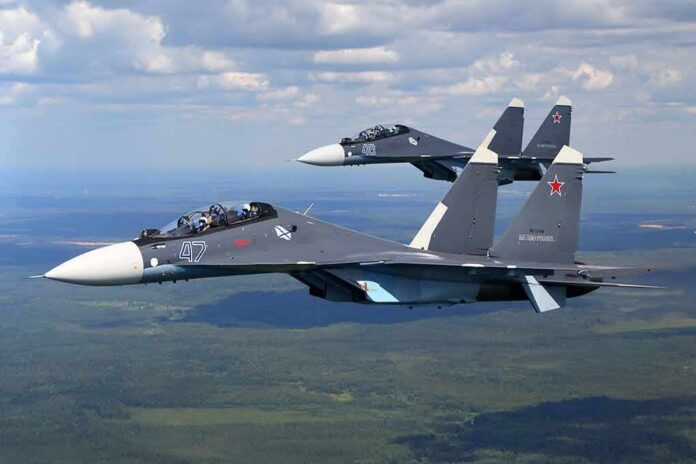
Russia’s Defense Ministry stated that one Su-30 fighter crashed during a scheduled training flight near Chernyakhovsk in the Kaliningrad region on October 21, 2026. Officials said both crew members ejected and were evacuated. They did not announce a cause. The Kyiv Independent and Anadolu Agency reported on the same incident, citing the training context and the pilot ejections. These reports do not show a second jet involved or any combat link to Ukraine.
Anadolu Agency reported the aircraft as an Su-30SM and said the pilots were injured but alive after ejection. That account also tied the crash to a training flight in Kaliningrad. No outlet cited official evidence that a second jet crashed that day. The Russian statement and the independent media reports align on one jet, two ejections, and an unclear cause. That keeps this event in the category of a non-combat training loss so far.
Why The “Two Jets Down” Narrative Does Not Hold
Social posts often jump from one verified incident to a broader claim. In this case, the available facts support only a single Su-30 down during training. The Defense Ministry’s statement mentions one aircraft and no hostile action. The two outlets that covered it reference the same event and add no second crash. Without a second, named source showing another wreck, the “two jets” line is not supported by current public evidence and should be treated as unproven.
This matters because Russia’s Kaliningrad exclave is a key military hub on the Baltic. A real double loss there would be notable. But accuracy comes first. One training crash is not the same as two fighters down or a combat defeat. Precision protects readers from spin. It also avoids giving cover to propaganda that tries to paint routine mishaps as proof of collapse or, on the other side, to dismiss real failures as “fake news” when numbers get inflated.
The War Picture: Slow, Costly, And Contested
The crash lands amid a wider fight over who has momentum. The Institute for the Study of War reported that Russian forces were not winning on the battlefield in late 2026. It assessed a net Russian loss of about 241 square kilometers since September 1 and an average advance of about 0.25 square kilometers per day in 2026. Analysts also noted Ukrainian operations that seized initiative in several sectors, challenging Moscow’s narrative of steady gains.
Russia still claims progress and leverage. President Vladimir Putin’s team has talked up territory and settlements taken this year. Yet those claims face pushback. The Institute for the Study of War assessed that Russian demands for full control of Ukraine’s heavily fortified “Fortress Belt” outpaced Moscow’s proven ability to take it. That gap matters in any talks. It warns that bold demands can mask limited battlefield results and aim to pressure Kyiv and the West.
What Conservatives Should Watch Next
Americans want facts, not fog. First, stick with confirmed details on the Kaliningrad event: one jet down in training, pilots rescued, cause unknown. Second, watch for official updates or new images that could change the count. Third, track verified maps of ground control, not slogans. Measured gains or losses on the line, not press claims, should guide any ceasefire ideas that touch U.S. interests and taxpayer support for Ukraine.
President Trump’s team faces a hard truth in Europe. Moscow will use bold claims to shape talks. Kyiv will counter with strikes and hard data when it can. Our job is to demand clarity before any deal that risks rewarding aggression or draining American wallets. That means verified numbers, public texts of proposals, and hard checks on what Russia can actually hold. Peace through strength needs proof on paper and on the map—not wishful talking points.
Sources:
criticalthreats.org, bbc.com, kyivindependent.com