
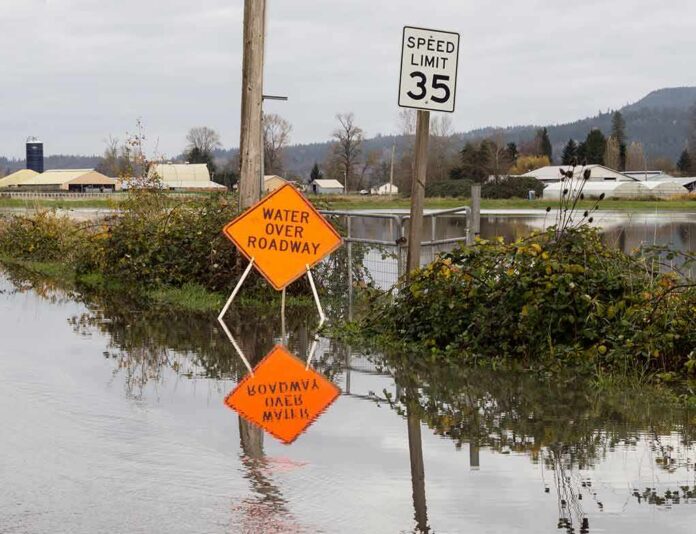
Millions of Americans are bracing for heavy rain that could turn the Great Plains into a flood zone fast.
Quick Take
- Forecasters say repeated rounds of rain may stretch across more than 700 miles.
- The Weather Prediction Center has outlined a moderate risk of excessive rainfall for the weekend.
- The Storm Prediction Center has placed parts of the Plains under an enhanced severe weather risk.
- Recent deadly flooding in the region shows how fast these storms can turn dangerous.
Rain Threat Builds Across the Plains
Millions of residents across the Central and Southern United States are facing another wet and stormy stretch. FOX Weather says the threat spans more than 700 miles, from Nebraska to western Florida, with repeated downpours already producing flash flooding in parts of southwestern Oklahoma [1]. The same report says the flash flood risk is being driven by already saturated soils, which makes each new round of rain more dangerous.
That setup matters because the National Weather Service defines a flash flood as flooding caused by heavy rain in a short period, usually less than six hours [14]. When the ground is already soaked, water runs off fast instead of soaking in. That raises the risk for roads, homes, and low-lying neighborhoods, especially where storms keep training over the same area. For families in the Plains, this is the kind of threat that can move from forecast to emergency in a hurry.
Warnings Cover Parts of Colorado, Kansas, and Nebraska
The Storm Prediction Center has issued an enhanced risk outlook for eastern Colorado, western and central Kansas, and southern Nebraska. In Nebraska, the National Weather Service office in Hastings also posted a flood watch for Greeley and Valley Counties and warned of 3 to 5 inches of rain [1]. That is enough rainfall to overwhelm drainage systems and small streams, especially if the heaviest bands stall over the same counties for several hours.
Forecasts in the research package vary on rainfall totals. FirstWarn Weather said its viewing area could see 1 to 3 inches, with isolated amounts above 4 inches, while the Hastings forecast called for 3 to 5 inches [3]. That gap does not erase the risk. It shows why forecasters watch these systems closely and update warnings as new radar and rain gauge data come in. The Weather Prediction Center also outlined a moderate risk of excessive rainfall for the June 20-21 period [4].
Recent Deadly Flooding Shows the Stakes
The danger is not theoretical. The National Weather Service office in Springfield reported two confirmed flood deaths during the June 13-14 storm system in southeast Kansas and southern Missouri [2]. That earlier event brought 4 to 8 inches of rain, showing how quickly heavy rain can become deadly when storms linger. The June 20 threat is still being forecast rather than confirmed, but the recent fatalities are a stark reminder of what these systems can do.
In addition to the risk of severe weather, we will also need to closely monitor the potential for flash flooding across the Colorado Plateau, the eastern Great Basin, the Desert Southwest, and from the High Plains south and eastward to a portion of the northern Gulf Coast.… https://t.co/yac8KQEMu6 pic.twitter.com/ZuxheAk8fM
— Anthony Duarte (@AnthonyDuarte03) June 24, 2026
Social media weather coverage has also leaned hard on alarm language, using phrases like “explosive storms” and “life-threatening” flood risk [5][15]. That kind of wording can help push people to pay attention, but it can also wear down trust if the public feels warnings are too dramatic. The better approach is plain and steady: tell people where the rain may fall, how much may come down, and why flooded roads can turn deadly in minutes. For conservative readers who value common sense, that is the point that matters most.
Why Forecasters Are Watching So Closely
The National Academies says flash flood forecasting depends on rainfall rates, local terrain, soil conditions, and real-time radar and gauge data [17]. That is why emergency offices do not wait for disaster before issuing watches. They are trying to get ahead of it. In this case, the concern is not just one storm but a wet pattern that could keep sending more rain into the same areas. That is how flash flooding gets out of control.
The broader weather pattern also adds pressure. FOX Weather says the flash flood threat could continue through Thursday across parts of Kansas and Missouri, with another 1 to 2 inches possible by Friday [1]. Even those amounts can cause trouble when the ground is already soaked and streams are running high. For people in the Great Plains, the practical answer is simple: stay alert, watch warnings closely, and do not drive through water that covers the road.
Sources:
[1] Web – Millions of Americans brace for flash flooding as heavy rainfall set …
[2] Web – Central Plains Severe Weather June 20, 2026: Enhanced Risk – iAlert
[3] Web – Severe Storms and Flooding June 13-14, 2026
[4] Web – FirstWarn Weather – Facebook
[5] YouTube – 20 JUNE 2026 – 430 AM CDT – FLOODING AND …
[14] Web – A Moderate risk for a flash flooding threat now highlights much of …
[15] Web – 6-22-26: Severe weather and flash flooding is possible across most …
[17] Web – Planned surveys of severe weather damage from June 21-22, 2026.