

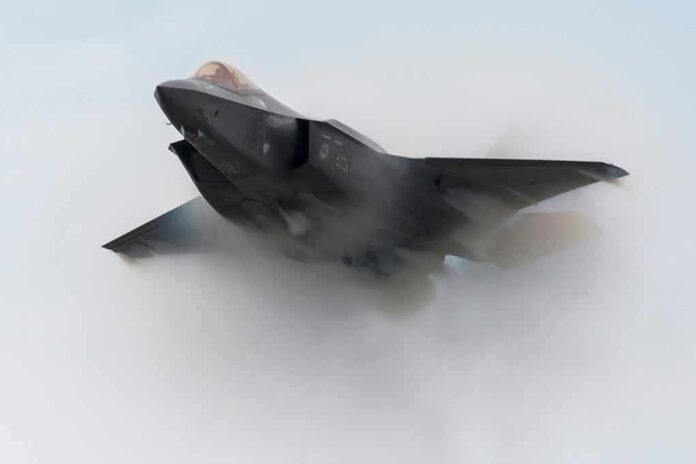
America’s most hyped spy plane — Lockheed Martin’s SR-72 “Son of Blackbird” — missed its 2025 flight deadline, and as of 2026, not a single prototype has left the ground.
Story Snapshot
- Lockheed Martin publicly revealed the SR-72 concept in 2013, promising a Mach 6 unmanned aircraft that would fly twice as fast as the SR-71 Blackbird.
- A 2025 prototype flight deadline came and went with no confirmed test flight and no public prototype rollout.
- The Pentagon and U.S. Air Force have never formally listed the SR-72 as an active program of record.
- Massive technical hurdles — including heat-resistant materials and a combined-cycle engine — remain unsolved at Mach 6 speeds.
A Bold Promise Made More Than a Decade Ago
Lockheed Martin first revealed the SR-72 concept in 2013 as a successor to the legendary SR-71 Blackbird. The company said the new aircraft would fly at speeds up to Mach 6 — six times the speed of sound. In 2016, Lockheed’s chief executive officer Marillyn Hewson announced progress toward a hypersonic prototype roughly the size of an F-22 fighter, priced under $1 billion. By late 2018, Lockheed confirmed a prototype flight was targeted for 2025, with full operational readiness set for 2030.
Lockheed engineers worked with Aerojet Rocketdyne to develop a turbine-based combined cycle engine. The design pairs a standard jet engine for takeoff with a scramjet for hypersonic flight. In 2018, Lockheed Vice President Jack O’Banion pointed to advances in additive manufacturing and computer modeling as key breakthroughs that made the design possible. On paper, the SR-72 looked like a game-changer — unmanned, reusable, and capable of reconnaissance and strike missions.
The 2025 Deadline Came and Went
As of early 2026, no confirmed flight tests have taken place. No prototype has been publicly rolled out or flown. The 2025 deadline has quietly slipped, with some analysts now guessing a more realistic window of 2027 to 2029 for any prototype flights. The National Interest reported bluntly that the SR-72 “exists only on paper” and that none of the aircraft have been built, let alone flown. The program’s own 2025 milestone has passed without a word from the Air Force or the Pentagon.
Making matters murkier, Lockheed’s own executive vice president Orlando Carvalho said in early 2018 — the same year the 2025 flight date was announced — that he could “unequivocally” confirm the SR-72 had not been built. The Pentagon has never formally acknowledged an operational SR-72 program, and the U.S. Air Force has never listed it among active or planned aircraft. Defense analysts at 19FortyFive summed up the program’s status in 2026 with one word: uncertainty.
Technical Walls and Budget Fog
The SR-72 faces real engineering problems that money alone cannot fix overnight. Flying at Mach 6 generates extreme heat that can destroy conventional aircraft materials. Building an engine that smoothly transitions from jet power to scramjet power — without stalling or breaking apart — remains one of the hardest challenges in aerospace. These combined-cycle propulsion and heat-resistance problems are the central obstacles blocking the program from moving forward.
Lockheed Martin revealed the Mach 6 SR-72 concept in 2013.
More than a decade later, no complete prototype or flight has been publicly verified. Hollywood supplied the Darkstar. Secrecy supplied the rumors.
SR-72 — The Unconfirmed Son of Blackbird#SR72 #SR71 #SkunkWorks… pic.twitter.com/0Z0hUhEdfE
— daryl (@shortsbydaryl) July 14, 2026
The SR-72 is not alone in struggling. The U.S. Army’s Long-Range Hypersonic Weapon, known as Dark Eagle, activated its first unit in December 2025 but entered 2026 without a single combat-ready round — a third straight missed deadline. The Air Force’s Hypersonic Attack Cruise Missile slipped 18 months, pushing its target to 2029. The Government Accountability Office has confirmed that testing bottlenecks and supply chain problems are crippling multiple U.S. hypersonic programs. Meanwhile, Russia and China keep advancing their own hypersonic weapons, raising the stakes for American defense planners. The SR-72 may still fly one day — but right now, it remains a promise, not a plane.
Sources:
nationalinterest.org, nationalsecurityjournal.org