

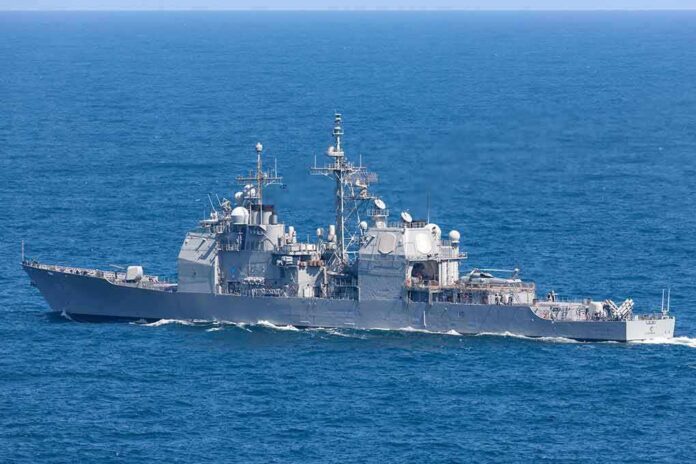
Iran’s latest attacks on civilian oil tankers in the Strait of Hormuz have triggered a sweeping U.S. military response aimed at keeping this vital waterway open and pushing back against Tehran’s growing aggression.
Story Snapshot
- The U.S. military is striking dozens of Iranian military targets after Iran hit multiple commercial ships near the Strait of Hormuz.
- Central Command says the goal is to punish “unwarranted aggression” and protect innocent civilian mariners using an international shipping lane.
- Iran is firing missiles and drones at U.S. bases in Gulf countries, claiming retaliation and control over the strait.
- The fight over Hormuz threatens global oil flows and hits Americans through energy prices and economic uncertainty.
U.S. Strikes Target Iran’s Ability to Hit Civilian Shipping
U.S. Central Command has launched a series of major strikes on Iranian military sites after Iran attacked oil tankers and cargo vessels transiting the Strait of Hormuz. American forces are targeting air defense systems, coastal radar, drone and missile storage, mine-laying facilities, and more than 60 fast attack boats used by Iran’s Islamic Revolutionary Guard Corps. Central Command calls Iran’s actions “unwarranted aggression” and says the strikes are meant to impose “heavy costs” for attacking commercial crews in an international waterway.
President Trump ordered the latest waves of strikes after a Panama-flagged tanker and other ships were hit by Iranian drones and projectiles while following routes agreed under a ceasefire framework. U.S. officials say the goal is not regime change but to degrade Iran’s tools for threatening shipping and to defend the principle of free navigation that has long anchored American power and the global energy market. U.S. aircraft, naval vessels, and one-way attack drones have been used to hit multiple coastal locations near key Iranian ports along the Hormuz approaches.
Iran Claims Control Over Hormuz and Expands Its Retaliation
Iran insists it has the right to control shipping routes through the Strait of Hormuz and has declared parts of the waterway closed or “restricted” during the conflict. Its navy and Revolutionary Guard units say they are striking ships that travel on “unauthorized routes,” especially those that bypass Iran’s claimed lanes or refuse to enter its territorial waters. After U.S. strikes, Iran has fired ballistic missiles and drones at U.S. bases in Kuwait, Bahrain, Jordan, Oman, and Qatar, describing these as punishment for renewed American bombings.
Iranian state media and the Revolutionary Guard claim to have hit “key U.S. military facilities,” including a Navy headquarters and air bases in Gulf states, though U.S. officials report no American fatalities so far. Tehran’s strategy is clear: use Hormuz as leverage, strike commercial vessels to show it can choke off energy flows, and then hit U.S. regional bases to raise the cost of any American effort to keep the strait open. This approach fits a long pattern in which Iran uses missiles, drones, mines, and fast boats to challenge Western forces without fighting a full-scale war.
Freedom of Navigation, Energy Security, and American Interests
The Strait of Hormuz carries roughly one-fifth of the world’s traded oil, making it one of the most important energy chokepoints on the planet. When Iran attacks tankers or tries to close the strait, global markets react quickly, driving up energy prices and feeding inflation that hits American families at the gas pump and in everyday goods. U.S. officials argue that defending free passage through Hormuz is about basic economic security for the United States and its allies, not just abstract geopolitical prestige.
US and Iran exchange strikes as they struggle over Strait of Hormuz https://t.co/zeqmnYLlee
— The Right News, Right Now. (@BradPorcellato) July 18, 2026
There is legal debate over exactly how international law applies in the strait, but many Western experts say commercial and military vessels enjoy a right of “innocent passage” that Iran cannot suspend at will. At the same time, Iran points to past U.S. and Israeli strikes on its territory and claims it is responding to outside aggression, not picking this fight. For American conservatives, the core issue remains simple: Iran is hitting civilian ships to gain power, and the U.S. is using force to protect trade, deter terrorism, and uphold the rules that keep the global economy working.
Escalation Risks and What Comes Next
Reports now describe Hormuz as a “severe” threat zone for shipping, with many companies rerouting or halting voyages due to the danger from Iranian weapons and the ongoing U.S.-Iran exchange of fire. U.S. Central Command continues to insist the strait is open and says American forces will keep striking Iranian assets that threaten civilian mariners and commercial vessels. Yet every new round of attacks raises the risk of miscalculation, wider regional war, and further spikes in energy costs that could pressure the U.S. economy and household budgets.
For Trump-supporting readers, this fight touches core values: protecting American lives, defending free trade routes, and refusing to let a hostile regime bully the world by targeting innocent crews at sea. The Trump administration now owns the task of standing firm, using decisive military power while trying to avoid a full-scale war that could drag on for years. As Iran tests U.S. resolve with rockets, drones, and tanker attacks, the question is whether sustained American pressure can restore deterrence and keep Hormuz open without a larger conflict.
Sources:
youtube.com, npr.org, reuters.com, aljazeera.com, centcom.mil, cbc.ca, cfr.org, tbsnews.net, cnbc.com