

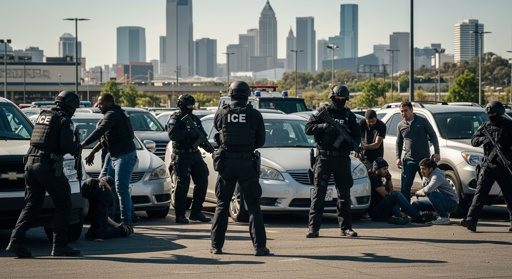
President Trump is pushing to resume Immigration and Customs Enforcement (ICE) traffic stops — a key tool for catching criminal illegal immigrants — even after the agency paused them following two fatal shootings in one week.
Story Snapshot
- Trump called ICE traffic stops one of the agency’s “most important” enforcement tools and wants them resumed after a brief pause.
- ICE temporarily halted most traffic stops after agents fatally shot two men in separate incidents within the same week.
- The Department of Homeland Security says ICE targets dangerous criminal illegal immigrants with prior convictions for homicide, sexual assault, and drug trafficking.
- ICE agents involved in both shootings were not wearing body cameras, raising accountability concerns even as Trump pushes forward.
Trump Pushes Back on ICE Pause
President Trump publicly backed ICE traffic stops this week, calling them one of the agency’s most important enforcement methods. His statement came after the Department of Homeland Security (DHS) ordered a temporary halt to most traffic stop operations. The pause followed two fatal shootings — both occurring within a single week — in which ICE agents shot and killed men who turned out not to be the original targets of the operations.
Trump’s comments appear to contradict the DHS pause, signaling he wants the tool back in use quickly. DHS Secretary Markwayne Mullin ordered the suspension while the agency reviewed its procedures. Trump’s push to reinstate the stops reflects his broader immigration enforcement agenda, which centers on removing criminal illegal immigrants from American communities as fast as possible.
Why ICE Uses Traffic Stops
Traffic stops are one of ICE’s most common arrest tactics in the field. Under federal law, ICE agents do not need a judicial warrant to pull over a vehicle. They only need “reasonable suspicion” — a legal standard meaning specific, observable facts suggesting someone inside may be violating immigration law or committing a crime. DHS states the agency focuses on illegal immigrants with prior convictions for homicide, sexual assault, drug trafficking, and gang involvement.
The legal authority for these stops comes from federal immigration statutes. Agents must base their suspicion on real, documented facts — not on a person’s race or ethnicity alone. When done correctly, the stops allow agents to act quickly without waiting for a judge to sign off, which supporters argue is critical when tracking dangerous fugitives who may flee at any moment.
Two Deadly Shootings Trigger the Pause
The pressure to pause came after two men were shot and killed by ICE agents in separate traffic stop operations within one week. In both cases, the men who died were not the intended targets. Reports confirmed neither victim was the person ICE was originally looking for. Both had work permits and documentation authorizing them to be in the United States. The shootings sparked outrage, protests, and calls for investigations by the Maine Attorney General, the Federal Bureau of Investigation (FBI), and the DHS Inspector General.
Trump: ICE should continue traffic stops after recent shootings, seeming to contradict new policy https://t.co/oB7gMThKgk
— TribLIVE.com (@TribLIVE) July 15, 2026
A significant accountability gap also came to light: agents involved in both shootings were not wearing body cameras. This is despite Congress allocating $20 million for body cameras in the current fiscal year budget and prior pledges by DHS leadership to distribute them nationwide. Without camera footage, there is no independent record of what happened during either stop — making it harder to defend the agency’s actions or hold anyone accountable if mistakes were made.
Balancing Enforcement and Accountability
The case for resuming traffic stops is straightforward from an enforcement standpoint. ICE needs fast, flexible tools to find and remove dangerous criminals who are in the country illegally. Waiting for a judicial warrant in every case could allow violent offenders to disappear. Trump’s position reflects the view that slowing enforcement puts American communities at greater risk than continuing the stops with proper oversight.
At the same time, the two fatal shootings show that mistakes can have deadly consequences. A 2025 court settlement in Illinois already requires ICE agents to document specific, factual reasons for each stop and prohibits pretextual stops — where agents claim a traffic reason but are actually conducting immigration enforcement. Getting body cameras deployed quickly would be a concrete step toward protecting both the public and the agents carrying out these operations. Enforcement and accountability are not opposites — both matter.
Sources:
immigrantjustice.org, brennancenter.org, birdsall-law.com