
Kamala Harris said she is “thinking about” a 2028 presidential run, putting Democrats on notice and energizing talk of a comeback campaign.
Story Highlights
- Harris told the National Action Network she “might” run in 2028 and is weighing public service roles.
- She pledged to be “more involved than ever before in 2028,” signaling an active national role.
- Polling shows Harris leading or competitive among Democrats, though results vary widely.
- No formal campaign or committee exists; her comments confirm consideration, not a launch.
Harris Signals Openness To Another Presidential Bid
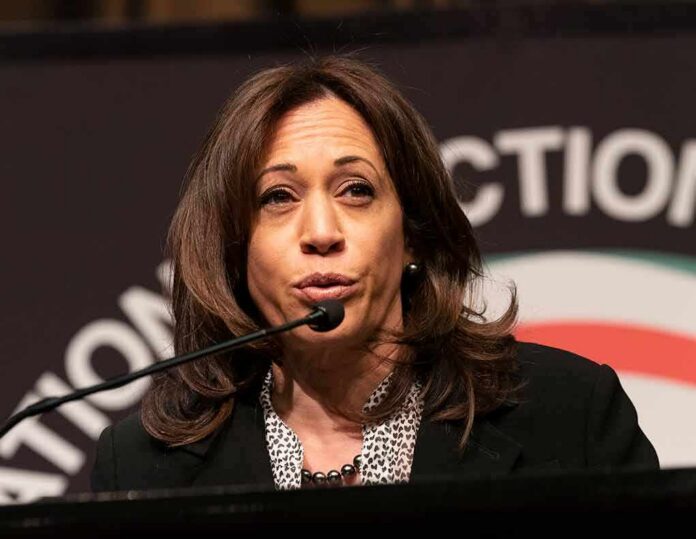
Vice President Kamala Harris told Rev. Al Sharpton at the National Action Network convention on April 10 that she “might” run for president in 2028 and is “thinking about it,” confirming that a new bid is under active consideration. Harris framed her thinking as a question of how best to serve the American people and said she would “keep you posted”. The remarks place her squarely in the early conversation, while stopping short of a formal announcement or an exploratory committee filing.
Harris also said she expects to be “more involved than ever before in 2028 because we can’t lose,” a promise that points to an expanded national push within the Democratic Party. The exchange, which included light-hearted banter about saving a seat at Sylvia’s Restaurant, still marked a clear signal of intent to stay central in party politics. The Associated Press, NBC News, and The New York Times all covered her comments as a public hint toward a third attempt.
Early Polls Give Harris Visibility But Show Volatility
Recent surveys show Harris with measurable early support in a hypothetical Democratic primary. One analysis put her around 30 percent among respondents naming a possible 2028 nominee, placing her in a leading tier. Another set of polls found her between 27 and 31 percent with Democrats and Democratic-leaning independents, again showing a frontrunner position in a fluid field. A separate survey reported 50 percent support among Democrats, underscoring her recognition and party reach.
Other polling paints a less commanding picture. One report showed Harris at just 12 percent with 45 percent undecided, highlighting the wide spread across surveys and the uncertainty of an unsettled field. Differences in timing, samples, and candidate lists explain the gap and warn against reading any single number as destiny. These are not primary votes. They are early snapshots that shift as contenders enter, debate, and raise money.
No Formal Campaign Yet, But A Familiar Early-Cycle Pattern
Harris has not announced a campaign, filed a committee, or laid out a launch plan. She has not released a donor strategy, early-state map, or senior staff list. Her words remain conditional: “I might” and “I’m thinking about it,” which signals intent to keep options open while testing interest among voters and donors. That approach fits a common pattern where national figures maintain visibility and flexibility before locking into a run.
2026 MIDTERMS DEBRIEF
The last 48 hrs have been insane, but if you think the big story here is a big Dem victory, you don't know the half of it. I'll walk you through:
– What happened (w/add'l background)
– What's planned for the future
– What we need to do next1. What Has…
— Wasson Watch Co. (@WassonWatch) November 6, 2026
For conservative readers watching the landscape under President Trump, Harris’s move matters. A re-energized Democratic figure with high name recognition can pull media focus, shape activist energy, and pressure donors. Her promise to be “more involved than ever” suggests louder pushes on issues that conservatives resist, from big-government programs to cultural fights. Tracking whether talk turns into filings, fundraising, and state organizing will show if this is spotlight management or the start of a real campaign.
Sources:
facebook.com, yahoo.com, thehill.com, pdclarion.com, nytimes.com, apnews.com, kentucky.com