
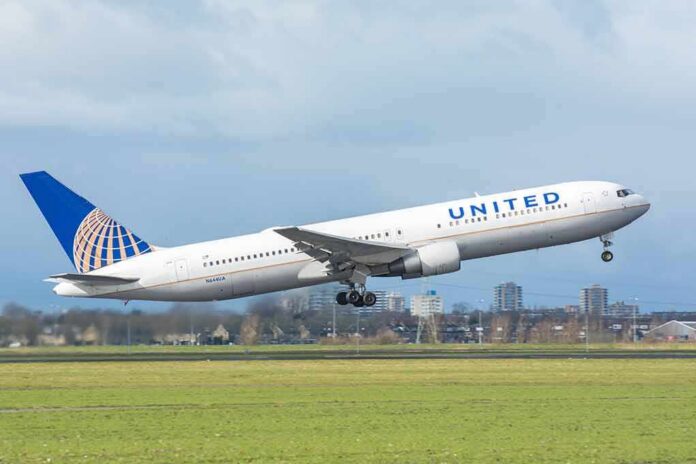
A United flight turned back to Las Vegas after a flight attendant reported a passenger’s text about “hijacking” and “crashing,” and police arrested a 25-year-old suspect.
Story Highlights
- Pilot reported a flight attendant saw texts about hijacking and crashing the plane.
- The United jet returned to Las Vegas about 10 minutes after takeoff and landed safely.
- Police arrested 25-year-old Dante Milne on a terrorism-related threat charge.
What Triggered The Turnback: Reported “Hijack” Texts Seen By Crew
Air traffic control audio captured the pilot of United Flight 1681 stating that a flight attendant saw a passenger texting about hijacking the aircraft. The pilot relayed that message to controllers shortly after departure from Las Vegas on a scheduled flight to Newark. Reports say the alleged texts included “gonna hijack this” and “crash ur row only,” which raised the alarm and prompted action by the crew and authorities.
United described the event as a “potential security concern,” a term airlines use when crew members observe a serious risk. Such language signals to airports and law enforcement that an immediate, coordinated response is needed. The crew treated the report as an active security issue and prioritized a safe return. That approach matches long-standing training after past hijackings and threats against commercial aviation.
How The Crew Responded: Immediate Return And Controlled Landing
Flight data cited in local reporting show the jet turned back roughly 10 minutes after takeoff. The pilot notified controllers, coordinated vectors back to Harry Reid International Airport, and landed without incident. Passengers and crew, estimated at about 150 and six respectively, remained safe throughout the return. The decision to land quickly limited risk and allowed police and federal partners to meet the aircraft at the gate.
Officials detained the passenger on arrival and began the standard security process. That process can include clearing the cabin, screening baggage, and separating witnesses for statements. United later reprotected travelers, with reports indicating the Newark-bound flight continued the next morning. The orderly response showed how cockpit doors, crew training, and coordination can neutralize risk before it grows.
Law Enforcement Action: Arrest And Terrorism-Related Charge
Local police identified the suspect as 25-year-old Dante Milne. Officers booked him on suspicion of making a threat or providing false information about an act of terrorism, a serious offense under state law. Media reports noted a detention at the Clark County Detention Center and initial court steps that follow an arrest of this kind. The charge reflects the gravity of explicit hijacking language in a commercial jet setting.
“Passenger disturbance.” That’s how Vegas local news described a potential hijacking in Las Vegas.
Here’s what happened. 👇
A flight attendant reportedly saw a passenger texting that he was going to HIJACK the plane—while they were already airborne. 😳
United 1681 was headed…
— Jedi Rich (@jedirich_) October 27, 2026
Some details remain limited at this stage. Reports reference the criminal complaint’s quoted messages but do not include the full document or a device forensic report. That is normal early in a case. The main facts are clear: a crew member saw alarming texts, the pilot declared a security concern, the flight landed safely, and police arrested the suspect. Federal aviation officials typically review such incidents to assess procedures and training.
Why It Matters To Travelers: Safety Protocols And Personal Responsibility
Air crews must act fast when they hear the words “hijack” or “crash.” They do not debate intent at 30,000 feet. They protect lives. That is the right standard. In today’s environment, reckless words about violence on a plane can trigger emergency responses, major delays, and criminal charges. Passengers should understand that threats—real or claimed as jokes—carry serious consequences for everyone on board and for the system that keeps flights safe.
Conservative Viewpoint: Security First, Consequences For Threats
Americans expect strong security, clear rules, and swift action when lives are at stake. This case shows frontline pros doing their jobs: a vigilant flight attendant, decisive pilots, and police ready to respond. That is how safety works. We also expect accountability. If investigators confirm that the texts said what is reported, courts should apply the law. Public safety depends on drawing a bright line against threats that disrupt travel and endanger families.
Sources:
cbsnews.com, 8newsnow.com, balleralert.com, cp24.com, travelandtourworld.com, ground.news