

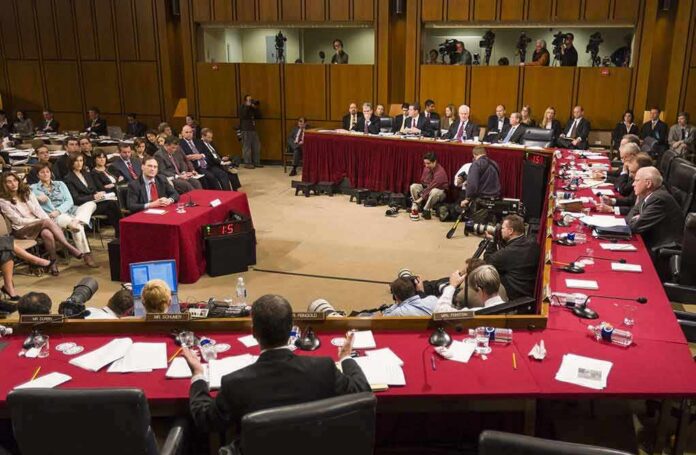
The fight over Todd Blanche’s attorney general nomination turns on one Republican senator’s insistence that assurances about January 6 and a controversial “anti-weaponization” fund be put in writing, not merely promised from the witness chair.
Key Points
- Senator Thom Tillis has drawn a bright-line standard: any attorney general nominee who excuses January 6 rioters or violence against police is, in his words, “dead on arrival.”
- In Blanche’s confirmation hearing, Tillis forced an on-the-record condemnation of the Capitol attack, then pivoted to demand written termination of a $1.7–1.8 billion DOJ “anti-weaponization” fund tied to President Trump’s IRS settlement.
- Tillis, joined by Senator John Cornyn, refused to advance Blanche out of the Senate Judiciary Committee until DOJ rewrote the settlement and memorialized Blanche’s assurances, stalling the nomination.
- Tillis has emphasized accountability mechanisms over personal trust, pressing for enforceable documentation on January 6, the fund, IRS audit immunity, and meetings with Jeffrey Epstein survivors.
- Blanche, for his part, has testified that the fund is “dead” and described January 6 as a heinous crime, arguing that the dispute is about paperwork rather than his substantive views.
How One Republican Senator Became a Gatekeeper on Blanche’s Nomination
To understand why Blanche’s nomination is hung up, you have to start with the institutional math. The Senate Judiciary Committee is closely divided; if all Democrats oppose President Trump’s nominee, a single Republican “no” or “not yet” can deadlock the committee and effectively bury the appointment before it ever reaches the floor. Thom Tillis of North Carolina occupies exactly that leverage point. He is a Republican, generally supportive of conservative judicial nominees, but he has carved out an explicit set of conditions for any attorney general pick in the post–January 6 era.
Over the past year, Tillis has been unusually blunt: he will not vote for an attorney general nominee who has “expressed even the slightest justification for the events of January 6th,” or who appears lenient toward rioters who assaulted Capitol Police officers. He has also said publicly that “anybody who didn’t back the blue on January 6” will not receive his support. In a committee structure where one Republican can stall the president’s choice, that combination of hard-edged rhetoric and procedural power turns Tillis into a gatekeeper. Blanche’s confirmation has become the test case.
Tillis’s January 6 Red Line: What He Asked Blanche to Say Under Oath
Tillis did not leave his January 6 standard in the realm of vague principle. In Blanche’s Judiciary Committee hearing, he walked through it in granular detail. He opened by telling Blanche he had “searched heaven and earth” for any statements excusing the Capitol riot and found only a passing comment at a C‑SPAN conference, then pressed the nominee directly on whether Capitol Police officers injured on January 6 were victims of a “heinous crime.” Blanche answered yes, adding that the perpetrators “should’ve been prosecuted and was,” a formulation designed to signal that he accepted both the moral gravity of the assault and the legitimacy of prosecutions already brought.
In other interviews, Tillis framed the standard in plainer language. On CNN, he said bluntly that Blanche “must condemn those involved in January 6 to get his vote,” and that “anybody who condoned their behavior will not get my vote.” Bloomberg Law summarized his posture as declaring any attorney general nominee who “said anything the least bit excusing the behavior of January 6th is dead on arrival.” Those are unusually categorical words in a confirmation environment that often trades in euphemism. They also reflect something broader: for Tillis, January 6 is not just another policy disagreement; it is a litmus test of whether a nominee treats violence against law enforcement as non-negotiable.
The Anti-Weaponization Fund and the IRS Settlement: Why Written Assurances Matter
If the January 6 exchange were the only friction point, Blanche might already be attorney general. The more complicated obstacle is a settlement the Justice Department struck to resolve President Trump’s lawsuit over leaked tax returns, which included an “anti-weaponization fund” approaching $1.8 billion and language that critics say could grant Trump and his family special protection from future IRS audits. The fund’s stated purpose was to compensate “victims of weaponization” by DOJ and IRS. In practice, detractors across both parties worried it could operate as a slush fund for Trump allies, potentially including January 6 participants.
Tillis and Cornyn have focused on two features: first, the existence of the fund at all; second, settlement terms that appear to offer Trump and his associates audit immunity not available to ordinary taxpayers. Blanche has tried to defuse the issue by testifying repeatedly that the fund is “dead,” that DOJ will not revive it, and that the settlement will not be used to funnel taxpayer money to January 6 defendants or other political allies. But Tillis has made clear oral reassurances are not enough. He and Cornyn have said their votes are contingent on the fund being “formally and permanently disbanded,” with the settlement rewritten accordingly.
That is why you have seen language like “otherwise we’ll just have to delay it” from Tillis, directed not at Blanche personally but at the administration’s reluctance to commit in writing. ABC News has reported that Tillis was “still waiting to see changes made to the IRS settlement” and that he wanted the written document to match Blanche’s sworn testimony that the fund was dead. From Tillis’s perspective, this is an accountability problem: he is prepared to take Blanche at his word, but he is not prepared to trust that word to outlast his own term in office absent enforceable documentation.
Process Conditions: Epstein Survivors, DOJ Independence, and Accountability After Tillis Retires
January 6 and the fund are only part of what Tillis has put on the table. During Blanche’s hearing and in subsequent interviews, he raised separate concerns about how DOJ has handled the Jeffrey Epstein saga and about the department’s independence from the White House. PBS and other outlets reported that Tillis said he would not vote Blanche out of committee unless the nominee agreed to meet with Epstein survivors and their representatives, an unusual but pointed condition aimed at forcing DOJ to confront past failures in handling sex-crimes cases involving powerful men.
On CBS’s “Face the Nation” and in conservative media, Tillis has also emphasized that he wants structural safeguards, not just personality-based assurances. He has described Blanche as negotiating in good faith, while suggesting that “we have somebody else in the way,” by which he appears to mean lawyers or political advisers around President Trump who are resisting changes to the settlement. Tillis has said he is seeking mechanisms that will hold the administration accountable after he leaves office, not simply pledges that depend on Blanche’s disposition. In effect, he is asking for a paper trail—a rewritten agreement, a formal certification, perhaps a statutory change—so that future officials cannot quietly resurrect a fund or exploit audit immunity language once the spotlight moves on.
How Cornyn and Tillis Used Committee Leverage to Stall the Nomination
The result of these layered conditions has been concrete procedural impact. With Democrats unified against Blanche, Republicans needed every GOP vote on Judiciary to advance the nomination. Once Tillis and Cornyn both held back, the committee simply could not proceed. The Hill reported that Chair Chuck Grassley canceled a scheduled vote after Tillis and Cornyn objected, and that both senators were “holding firm” that their support would depend on written assurances disbanding the fund and addressing the IRS immunity terms.
CNN and other outlets have described this as a two-senator bloc with effective veto power: a single Republican “no” could doom Blanche in committee, and at least one Democrat would have to cross over to counterbalance that holdout. In practice, neither Cornyn nor Tillis budged. Cornyn publicly canceled a planned meeting with Blanche, saying he was “not prepared to vote yes” until DOJ provided the documentation he requested. Tillis likewise signaled he was “not prepared” to support advancement until he saw the words on paper, even as he praised Blanche personally as honest and engaging in good faith.
The White House response has underscored the tension. President Trump has attacked Tillis and Cornyn in public and floated the idea of temporarily withdrawing Blanche’s nomination and “putting him back” once those senators are out of office. That threat is precisely the sort of scenario Tillis says he is trying to guard against: a world in which the administration waits out individual oversight voices rather than addressing the underlying accountability questions.
Blanche’s Case: Condemning January 6 and Declaring the Fund “Dead”
None of this means Blanche has refused to engage the senators’ concerns. The hearing record shows him doing the opposite. On January 6, Blanche’s answer to Tillis’s central question was unequivocal: injured Capitol Police officers were victims of a “heinous crime,” and those responsible should have been prosecuted. That is direct evidence that, at least in that exchange, Blanche met the verbal standard Tillis laid down that he must condemn those involved in January 6.
On the anti-weaponization fund, Blanche has likewise testified that it is “dead” and has no intention of reviving it. Multiple news reports describing the standoff acknowledge that the dispute is not over Blanche’s oral position; it is over converting that position into binding text. Tillis himself has said Blanche is “negotiating in good faith,” and has shifted his criticism toward unnamed figures in Trump’s orbit who, in his view, are blocking the changes DOJ needs to make.
Supporters of Blanche argue that this record undercuts any narrative that he is sympathetic to January 6 defendants or eager to weaponize DOJ resources for partisan allies. They also note that the available coverage, while rich in political commentary, does not yet include the settlement’s full text or documentary proof that January 6 defendants were eligible for fund payments. In that sense, Blanche’s camp can claim that some of the fears about the fund rest on hypotheticals rather than the black-letter agreement.
What This Fight Reveals About Modern Confirmation Politics
Stepping back, the Blanche–Tillis clash is less an anomaly than a concentrated example of a broader pattern in modern confirmation politics. Senators who sit on key committees increasingly use their leverage not merely to assess a nominee’s résumé or ideology, but to extract written commitments on discrete legal and ethical questions—especially in the justice system, where oral assurances are seen as reversible and easily forgotten. January 6 has become one of those proxy issues: how a nominee talks about the riot, about violence against police, and about defendants who claim political martyrdom has turned into a test of institutional legitimacy.
Tillis’s approach combines that symbolism with a lawyer’s attention to documentation. He is not simply asking Blanche to condemn January 6; he is requiring that DOJ’s settlement machinery be scrubbed of provisions that, in his view, might someday be used to subsidize rioters or insulate the president from ordinary legal scrutiny. Whether readers agree with his politics or not, the posture is clear: trust is insufficient, and the system must be designed so that no single attorney general’s goodwill is the only thing standing between a controversial fund and its potential abuse.
John Cornyn and Thom Tillis reportedly refused to advance Todd Blanche’s AG nomination unless DOJ narrowed an IRS immunity settlement protecting Trump and his family. Good…Except for the part where doing the right thing shouldn’t only happen when you’re not seeking reelection
— Karly Kingsley (@karlykingsley) July 31, 2026
Where the Dispute Goes From Here
Because this is an institutional fight rather than a one-day flare-up, its resolution—whenever it comes—will carry consequences beyond Blanche himself. If DOJ produces written assurances terminating the fund and narrowing the IRS settlement, Tillis will have demonstrated that a single senator, properly situated, can force substantive changes to executive-branch legal arrangements. If the administration instead follows Trump’s suggestion and waits for retirements, it will confirm Tillis’s fear that watchdogs can be outlasted, and that oral testimony without documentation is a fragile constraint.
Either way, the episode is a reminder that attorney general nominations now sit at the intersection of criminal accountability, partisan distrust, and the mechanics of administrative law. Blanche’s predicament is not just about who should run the Justice Department; it is about whether the department’s own deals and funds are structured to serve the rule of law or to serve the interests of those in power—and who, in the Senate, is willing to insist that the answer be written down.
Sources:
townhall.com, nytimes.com, news.bloomberglaw.com, youtube.com, cnn.com, nypost.com, thefederalist.com, wsj.com, punchbowl.news, abcnews.com, facebook.com, pbs.org, foxnews.com, charlotteobserver.com, newsobserver.com, thehill.com, breitbart.com, washingtonexaminer.com