
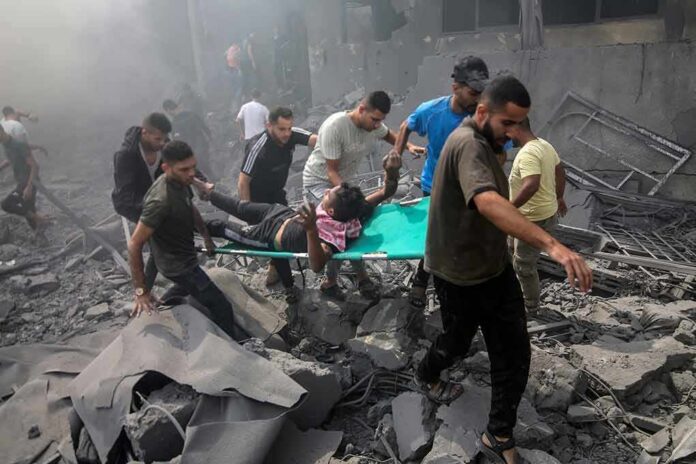
A powerful quake shattered Kumamoto, and the aerial footage now reveals just how quickly even a modern city can be brought to its knees.
Story Snapshot
- A major earthquake struck Kumamoto Prefecture with a preliminary magnitude of 7.1 and shallow depth.
- A tsunami advisory was issued for nearby coasts, then lifted after no significant waves were detected.
- A shopping mall partially collapsed after an explosion, with people missing and workers reportedly trapped inside.
- Aerial images show collapsed buildings, broken highways, power outages, and large-scale rescue operations across the region.
Quake Slams Kumamoto, Tsunami Advisory Follows
Japan’s Kumamoto Prefecture was rocked by a strong earthquake on July 28, striking just after 4:27 p.m. local time and measuring a preliminary magnitude of 7.1 at a shallow depth of about 10 kilometers. The shake reached level seven, the top of Japan’s intensity scale, in parts of the region, meaning violent ground motion and high damage risk. Officials and reporters describe buildings swaying, walls cracking, and fires starting near the epicenter as stunned residents rushed into the streets.
The Japan Meteorological Agency quickly issued tsunami advisories for coastal areas along the Ariake and Yatsushiro seas, warning of possible waves up to about one meter. Emergency alerts reached coastal communities, and people were urged to leave the water and keep away from the shore. Within a couple of hours, authorities lifted the advisories after no dangerous tsunami was recorded, but they told residents to stay alert for strong aftershocks over the next several days. This fast warning-and-lift cycle shows how serious even a non‑tsunami quake is treated in Japan.
Aerial Footage Shows Widespread Damage and a Stricken Mall
Aerial video from Japanese and international media shows collapsed homes, damaged commercial buildings, and twisted sections of the Kyushu Expressway cutting through Kumamoto’s landscape. One major focus is the Aeon Mall in Kashima Town, where an explosion after the quake blew out part of the structure and left large portions caved in. Photos and video from above show the mall’s roof torn open, debris scattered across parking areas, and smoke or dust hanging over the complex as fire and police crews move in.
Local outlets report that people were missing or trapped inside the mall after the blast and collapse, though early reports did not pin down a firm number. Rescue teams are seen combing through rubble, cutting into damaged sections, and using ladders and cranes to reach upper levels. Aerial shots from Nippon Television and other broadcasters capture these scenes alongside broken roads, toppled chimneys, and long lines of emergency vehicles, giving a sobering picture of how fast a thriving shopping center can turn into a disaster zone.
Casualties, Power Outages, and Transport Disruption
National broadcaster reports and wire services say the quake injured dozens of people across Kumamoto, with casualty figures rising through the night as more information reached Tokyo. Prime Minister Sanae Takaichi told reporters that power outages, fires, road and bridge damage, and collapsed buildings had already been confirmed, and that the full human cost was still being counted. Some outlets later reported at least a dozen deaths and more than fifty injuries, with numbers remaining fluid as rescue teams searched damaged areas.
Kyushu Electric Power said roughly 40,000 homes lost electricity in the region after the shock, leaving families in the dark as night fell. Rail operator JR Kyushu suspended train services, including high‑speed bullet trains, while engineers checked tracks, tunnels, and bridges for damage. Aerial images show gaps and buckled sections on the Kyushu Expressway near Yatsushiro, highlighting how one strong quake can disrupt key transport lines that millions depend on. For Americans, this is a reminder of how fragile infrastructure is when nature strikes, and why energy and transport resilience matter.
Aftershocks, Nuclear Safety, and Lessons for Preparedness
Officials warned that aftershocks could continue for days, and early reports already described additional tremors following the main event. Fire and police units in Kumamoto used helicopters to survey damage from the air, helping direct ground teams to the worst‑hit neighborhoods and key facilities. At the same time, Japan’s Nuclear Regulation Authority checked nearby nuclear plants and reported no abnormalities, easing fears of a radiation incident on top of the earthquake damage. That nuclear safety message is critical in a country that still remembers Fukushima.
Japanese Prime Minister Sanae Takaichi said Wednesday morning that the death toll from the powerful Kumamoto earthquake had risen to 13 as of 8:30 a.m. local time.#japan #kumamoto #earthquake #cloud #cumulonimbus #news #disaster #fyp pic.twitter.com/33Nwx8D2vK
— REALTIMZZ96 (@MLTTimzz) July 30, 2026
This disaster response shows a mix of strengths and limits that matter for conservative readers at home. Japan’s fast alerts, clear tsunami guidance, and visible local rescue work reflect serious planning and respect for human life, not endless committee talk. But the confusion over early magnitude numbers and casualty counts also shows how big systems struggle under time pressure and changing data. For Americans who care about local control and honest reporting, the Kumamoto quake is a reminder to demand strong, practical preparedness while staying skeptical of dramatic early headlines that may shift as facts catch up.
Sources:
youtube.com, cnn.com, aljazeera.com, nytimes.com, npr.org, usatoday.com, theguardian.com, washingtonpost.com, nbcnews.com, reuters.com