
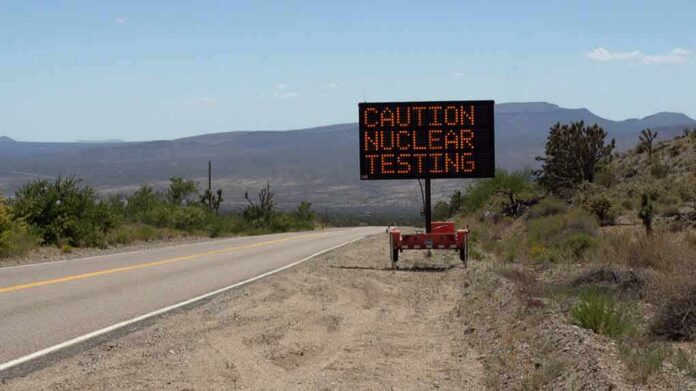
America quietly blew up conventional charges deep under Nevada to sharpen our eyes for covert nuclear blasts that hostile regimes might try to hide.
Story Highlights
- The Energy Department ran a non-nuclear, underground explosive experiment in Nevada to boost detection of hidden nuclear tests.
- The test focused on hard-to-spot “decoupled” blasts that dampen seismic signals.
- Sensors gathered data to validate models and refine detection algorithms used worldwide.
- Officials cited the need to spot very low-yield tests by adversaries like China and Russia.
What Happened Underground And Why It Matters
The National Nuclear Security Administration said it conducted a subsurface, non-nuclear chemical high-explosive experiment at the Nevada National Security Site. The agency stated the goal was to improve the United States’ ability to detect low-yield nuclear explosions, the kind adversaries might try to hide underground. The experiment took place in a tunnel complex known as P Tunnel in Area 12, where America has long run scientific trials to improve monitoring tools, not to build or test nuclear weapons.
Officials explained that the test mimicked conditions that can “decouple” an underground blast from the surrounding rock, which makes the seismic signature far smaller and harder to catch. That scenario is a known challenge in nuclear monitoring. By simulating it with chemical high explosives instead of nuclear material, scientists can gather clean data while staying within treaty and safety bounds. This helps close loopholes that bad actors might try to exploit to dodge detection.
How The Test Collected Data To Catch Cheaters
Scientists deployed a mix of instruments to record the blast and its after-effects. Reporting tied to the agency’s description lists accelerometers, seismometers, infrasound sensors, electromagnetic sensors, chemical and radiotracer samplers, and weather sensors as part of the package. These tools capture ground motion, air pressure waves, and trace materials that may leak into rock or air. The data then feed computer models that predict what a small or masked explosion should look like to our global monitoring networks.
Agency materials and prior technical work show that these experiments are designed to validate models and refine algorithms used by America’s detection systems. Better models mean faster, more confident calls when a suspicious event occurs overseas. That supports global nonproliferation and protects our troops, our allies, and our homeland. It also gives U.S. leaders leverage in diplomacy because our evidence is stronger when we can point to hard data, not guesswork.
The Strategic Stakes With China, Russia, And Rogue States
The Washington Times reported that officials linked the effort to spotting very small nuclear tests, including those that could be conducted by China or Russia in ways meant to dull seismic alarms. While the Nevada shot was non-nuclear, the mission supports America’s promise to hold violators accountable. When rivals play games underground, our job is to know it and prove it. That deters cheating, backs up treaty enforcement, and keeps our deterrent credible without new nuclear explosions at home.
Independent technical studies have long shown that detection gets harder as yields drop and when blasts are engineered to hide the signal. That is why the United States invests in careful, repeatable chemical shots and deep sensor arrays to push sensitivity lower year after year. This work is not about building bombs. It is about guarding the peace with facts, precision, and tools that expose anyone who would threaten Americans from the shadows.
What This Means For Security, Taxpayers, And The Rule Of Law
President Trump’s administration is now responsible for federal security actions, and this step aligns with a simple promise: peace through strength and honesty. The Nevada experiment used chemical high explosives and radiotracers, not nuclear material, and fell squarely inside U.S. law and international commitments. That matters for trust and for results. Strong verification means we do not need to rely on wishful thinking when rivals deny obvious facts.
🔴 U.S. detonates conventional explosives in Nevada tunnel to simulate concealed nuclear test
The National Nuclear Security Administration conducted a test yesterday in P Tunnel at Nevada National Security Site using chemical high-explosives and radiotracers to replicate a… pic.twitter.com/OMuxj3UUue
— NewsTongue (@NewsTongueX) October 1, 2026
For taxpayers, this kind of precise science is a smart buy. It bolsters early warning and gives clear evidence when someone tries to cheat. It also helps our allies trust American assessments and prevents panic from rumors. When detection improves, the chance of surprise drops. That is how we protect families, defend the Constitution, and keep faith with service members who stand watch while our scientists make sure every hidden tremor has a name and a source.
Sources:
asiatimes.com, inshorts.com, washingtontimes.com, energy.gov, newsnationnow.com