

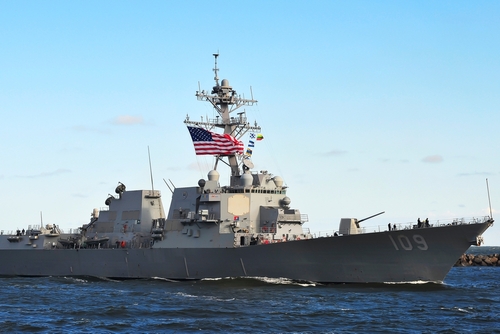
Air raid sirens blared across Bahrain as Iran launched a wave of ballistic missiles and attack drones at American military installations and Gulf Arab allies — and the United States shot most of them down before they could hit their targets.
Story Highlights
- Iran launched ballistic missiles and one-way attack drones targeting U.S. military positions in Kuwait and Bahrain, as well as maritime traffic near the Strait of Hormuz.
- U.S. Central Command (CENTCOM) intercepted six Iranian ballistic missiles and shot down multiple attack drones; a seventh missile failed to reach its intended target.
- Gulf states including Bahrain and Kuwait activated air defenses and jointly condemned the Iranian strikes, with Bahrain reporting it downed three Iranian missiles and a wave of drones.
- Iran disputed key details of the exchange, including which side struck Kuwait International Airport — a claim CENTCOM flatly rejected, calling it “Totally FALSE.”
Missiles and Drones Over the Gulf
Iran launched ballistic missiles and one-way attack drones at U.S. military-related targets in Kuwait and Bahrain in one of the most direct exchanges of fire between American and Iranian forces in recent memory. U.S. Central Command reported that six Iranian ballistic missiles were intercepted and a seventh failed to reach its target. American forces also shot down four Iranian attack drones that were launched toward the Strait of Hormuz, one of the world’s most critical maritime chokepoints for global oil shipments. No casualties among American personnel were reported in the initial assessment. [2]
Gulf states did not sit on the sidelines. Bahrain’s military confirmed it intercepted three Iranian missiles and a wave of drones, directly defending its own airspace. Kuwait activated its air defenses as well. Several Gulf nations issued a joint condemnation of Iran’s strikes, signaling that the regional response was coordinated and unified rather than fragmented. [3] The scale of the attack — described as involving hundreds of missiles and drones across the broader 24-hour period — underscores how rapidly the confrontation escalated. [3]
Iran Claims Victory, U.S. Pushes Back Hard
Iran’s government offered a sharply different account of events. Iranian officials claimed their forces successfully targeted an American military vessel in the Sea of Oman — a claim the United States flatly denied. [1] The most pointed dispute centered on Kuwait International Airport, where damage occurred. Iran suggested the airport was struck by a misdirected American interceptor missile rather than an Iranian drone. U.S. Central Command responded directly, calling that explanation “Totally FALSE” and stating that Iran struck the civilian airport with drones in what CENTCOM described as “a deliberate, calculated, and unjustified attack.” [6]
This pattern of competing claims — rapid assertions of success followed by official rebuttals — is not new in U.S.-Iran confrontations. Radar tracks, engagement logs, and battle damage assessments that could independently verify either side’s account typically remain classified or are only partially released to the public. [13] What the public receives is largely the official narrative from each government, leaving independent verification difficult in the immediate aftermath of fast-moving military exchanges. [14]
A Chokepoint the World Cannot Afford to Lose
The Strait of Hormuz is not just a military flashpoint — it is the passage through which roughly 20 percent of the world’s oil supply flows. Iranian drones launched toward civilian vessels transiting the strait represent a direct threat to global energy markets and supply chains that affect everyday Americans at the gas pump and in grocery store prices. U.S. forces shot down three one-way attack drones targeting civilian shipping in the area, according to CENTCOM. [13] The economic stakes of any prolonged disruption in that corridor are enormous.
For Americans already frustrated by years of energy price volatility and the sense that Washington’s foreign policy decisions carry real costs at home, the Gulf escalation is a reminder of how quickly distant conflicts can translate into domestic consequences. Whether the current military exchanges stabilize into a deterrent standoff or spiral further depends on decisions being made in Tehran and Washington — decisions that most ordinary citizens have no visibility into and little ability to influence. What is clear is that U.S. forces are actively engaged in combat operations in the Gulf, and the situation remains fluid. [5] [14]
Sources:
[1] Web – U.S. forces shot down Iranian missiles and drones aimed toward Gulf …
[2] YouTube – US Shoots Down Iran’s Warship Strike Claim; Gulf Tensions Soar
[3] YouTube – ON CAM: Iranian Ballistic Fury Hits ‘AMERICAN BASES’
[5] Web – U.S. Shot Down Iranian Missiles and Drones Aimed at American …
[6] YouTube – Iranian drone attacks on Kuwait and Bahrain after US attacks on Iran
[13] Web – Iran Air Flight 655 – Wikipedia
[14] Web – US Forces Intercept Iranian Missiles and Drones as Tensions Persist …