

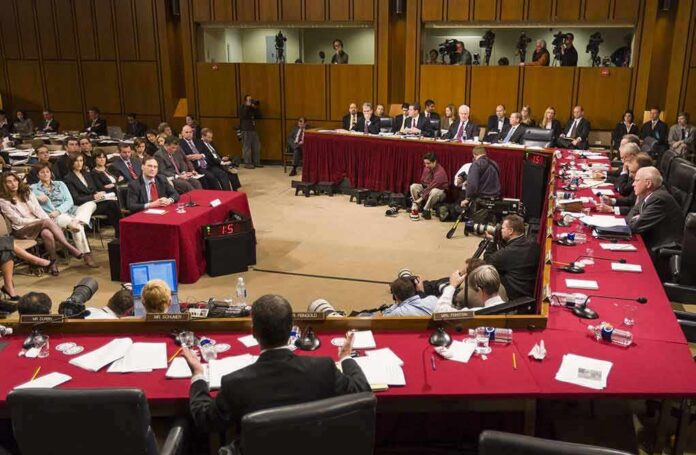
The real story in Pete Hegseth’s Senate testimony is not the theater; it is the familiar Washington fight over whether war costs belong in the base budget, in a supplemental, or in the shadows between the two. Hegseth’s defense of the request was built on a classic national-security argument: replenish readiness fast, restore munitions capacity, and do not mistake emergency funding for a substitute for the full defense budget.
Key Points
- Hegseth presented the supplemental as an urgent readiness-and-replenishment measure, not a replacement for the Pentagon’s base budget.
- The request was publicly framed around troop pay, equipment replacement, munitions production, and other immediate military needs.
- Critics focused less on any single line item than on transparency, shifting cost estimates, and contradictions in the administration’s Iran narrative.
- The deeper dispute is institutional: how much wartime spending should move through emergency channels, and how much scrutiny that process really receives.
What Hegseth Said the Money Was For
Hegseth’s strongest line of argument was administrative rather than theatrical. He told senators that the supplemental was “an urgent necessary injection of resources” for immediate departmental needs and insisted it was “not a substitute for the president’s full $1.5 trillion base budget request.” In other words, he drew a sharp distinction between the ordinary defense budget and the emergency money needed to patch holes created by current operations.
He then made the request legible in two broad buckets. The first was readiness: $21 billion for military pay, equipment replacement, forward-deployed forces, fuel stabilization, personnel growth, and National Guard support. The second was capability: $46 billion to expand production lines and speed delivery of high-demand munitions, including solid rocket motors, JDAMs, hypersonics, and counter-drone systems. That structure matters because it is the standard way the Pentagon justifies supplemental spending: one part repairs the force you already have, the other part tries to refill the magazines and industrial base that war has drained.
This is also why the request landed in a Senate appropriations hearing rather than in a cable-news vacuum. Hegseth, Joint Chiefs chair Dan Caine, and Brooke Rollins were all appearing through formal congressional channels, which gave the administration a procedural claim even as senators challenged the substance. The public case, in other words, was not that Congress should rubber-stamp the money; it was that the money had already acquired the urgency of wartime replenishment.
The Historical Pattern Behind Supplemental War Funding
The mechanics of this dispute are older than the personalities involved. Congressional Research Service data show that since FY1990 Congress has generally funded combat operations with supplemental appropriations, sometimes alongside regular appropriations and sometimes instead of them. That history matters because supplemental funding is politically useful: it lets administrations move quickly when conditions change. It is also politically suspect, because critics have long argued that emergency channels can soften oversight and obscure the real cost of war.
That is the deeper frame around Hegseth’s testimony. His supporters can point to a durable institutional habit: when operations create real readiness gaps or unexpected replenishment demands, Congress often funds them outside the normal cycle. His critics can point to the darker side of the same habit: supplemental spending can become a parallel budget, one that is easier to sell as necessity than to scrutinize as policy. The fight over this request is therefore not an anomaly. It is a recurring feature of modern American war finance.
Where the Democratic Case Is Strongest
The most forceful criticism does not rest on denying that the Pentagon has needs. It rests on the claim that the administration has not been consistent, transparent, or disciplined in explaining those needs. Reporting and hearing coverage place the Iran-war price tag at different points over time, including $200 billion in March, then lower figures in later coverage, then a White House request of $87.6 billion. That shifting public number gives Democrats a credible argument that the request has not been presented as a fixed, bounded necessity.
The second line of criticism is more damaging because it reaches the level of credibility. Senators, especially Jon Ossoff and Patty Murray, pressed Hegseth on the contrast between his earlier claims that Iran’s military was destroyed or combat ineffective and later acknowledgments that Iran retained underground missile capability. That does not prove the funding request is unjustified, but it does weaken the administration’s public posture. If the war was already described as a decisive victory, the case for a large continuing replenishment package becomes harder to sell without additional evidence.
There is also a process critique with real force. Democrats argued that the administration was trying to move enormous sums without the normal level of documentary clarity, and they objected to the possibility that the package bundled military funding with other priorities. Even if those objections do not by themselves disprove the need for money, they attack the credibility of the package as a clean, narrowly tailored supplemental. That is a legitimate oversight argument, not just partisan theater.
What Democrats do not yet have, at least in the public record available here, is line-item counterproof that the readiness tranche or the munitions tranche is unnecessary. They have process criticism, strategic criticism, and credibility criticism. They do not yet have the audited stockpile data, program-by-program execution tables, or detailed replacement-cost analysis that would decisively refute Hegseth’s numbers at the accounting level.
The US war with Iran has cost approximately $37.5 billion so far, Defence Secretary Pete Hegseth told lawmakers, up nearly $8 billion from the Pentagon’s previous estimate in May. Hegseth urged Congress to approve an additional $87 billion in Pentagon funding, including $67… pic.twitter.com/VRRy2Wz9nf
— APT News (@APT__News) July 22, 2026
The Iran Cost Argument: Why It Resonates and Why It Is Vulnerable
Hegseth also tried to make the supplemental feel inevitable by attaching it to a cost narrative. News coverage reported his estimate that the war in Iran had already cost about $37.5 billion, with current spending and projected needs still running through the fiscal year. That kind of figure is politically powerful because it transforms an abstract request into a running tab. Once a conflict has a price tag, opponents are no longer just debating policy; they are debating whether the country is paying enough, too much, or for the wrong results.
But the same move exposes the administration to scrutiny. Cost estimates that move from roughly $200 billion to $95 billion to $67 billion to $87.6 billion invite a simple question: which number is the actual defense case, and which is a rhetorical placeholder? When the answer is unclear, opponents can plausibly argue that the administration is treating the supplemental as a moving target rather than a disciplined request. That is especially damaging in appropriations politics, where credibility is often worth more than volume.
This is why the dispute is bigger than the particulars of Iran. Every wartime supplemental creates the same tension between urgency and accountability. Pentagon leaders want flexibility, speed, and authority to replace losses before they metastasize into readiness problems. Congress wants justification, specificity, and proof that emergency dollars are not duplicating work already funded in the base budget. Hegseth’s testimony fell squarely into that old pattern, and so did the skepticism it provoked.
What the Hearing Revealed About Political Risk
Hegseth’s rhetorical advantage was clarity. He gave senators a familiar defense logic: the world is dangerous, the force must be sustained, and deterrence is cheaper than failure. His vulnerability was also clarity. Once the administration has publicly declared victory, or near-victory, over Iran, every fresh request for tens of billions in replenishment looks like an admission that the war is neither contained nor cheaply won.
That tension is why the hearing generated more than partisan noise. It exposed the narrow ridge on which supplemental war funding always walks. Too little detail, and critics call it a blank check. Too much optimism, and the supplemental reads like a contradiction. Too much process, and urgency is lost. Too much urgency, and oversight disappears. Hegseth’s testimony did not resolve that dilemma; it illustrated it with unusual clarity.
The lasting significance is not that one side scored a debating point. It is that the administration’s war-financing posture is vulnerable on the old fault lines that have shaped American defense budgeting for decades: shifting numbers, compressed timelines, limited public documentation, and the perennial temptation to sell war costs as temporary exceptions rather than durable obligations.
Sources:
redstate.com, thehill.com, theguardian.com, nytimes.com, washingtontimes.com, abcnews4.com, wsls.com