

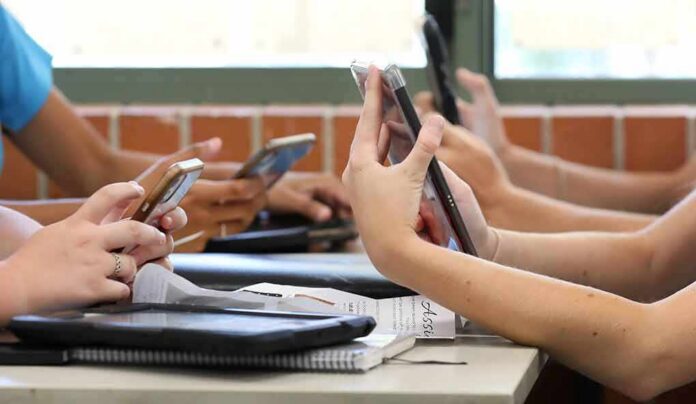
A new Harvard analysis finds locking up phones at school adds one to two weeks of learning a year — a small win with big implications for discipline and focus.
Story Highlights
- Harvard researchers report strict, all-day phone pouches boost annual math and reading growth by about 0.01 standard deviations, or one to two weeks of learning.
- The study tracks 3.3 million students across 4,600 schools and ties gains to schools that lock phones all day, not partial bans.
- Other peer-reviewed work finds average test-score effects near zero overall, with gains strongest in high school and weaker in middle school.
- Results suggest phone-free classrooms are a low-cost way to restore order, focus, and steady learning time.
Harvard Team Links Lockable Pouches To Extra Learning Time
Harvard’s Center for Education Policy Research reported that schools using all-day lockable phone pouches saw faster gains in math and reading. The increase measured about 0.01 standard deviations in annual achievement growth. The team said that equals roughly one to two weeks of added learning time each year. Researchers analyzed individual student growth before and after bans for 3.3 million students in 4,600 schools. The design focused on strict, bell-to-bell phone restrictions, not loose rules.
Researchers emphasized that the benefit shows up when phones stay out of reach. Lockable pouches prevent quick peeks, side texts, and social media during class. The Harvard brief said these tighter rules delivered modest but real academic gains. The project, built with partners including testing data experts, compared students to themselves over time. That design helps separate the ban from other changes at the same schools, giving the result more weight for leaders and parents.
What “Modest” Means And Where Gains Show Up Most
Several outlets and scholars stress the gains are modest, not massive. A separate national study tied to the same line of research found average test-score effects near zero overall. It reported that high schools saw small positive gains, especially in math, while middle schools saw small negative effects. This pattern helps explain why the average can look flat, even when certain grades benefit. It also warns against one-size-fits-all claims across ages and campuses.
Harvard’s student-level analysis still points to a clear, practical upside for strict bans. Small gains matter when schools add up minutes of focus across a year. A week or two of extra learning can help close gaps and rebuild habits after the past decade’s slide in attention and performance. Schools that want results need strong enforcement. Partial bans or “phones in backpacks” leave temptations close at hand. The data say real distance makes the difference.
Why This Matters For Parents, Teachers, And Local Boards
Teachers have fought digital distraction for years. Many say phones fuel side conversations, social drama, and cheating. Lockable pouches reduce those battles so adults can teach and students can learn. The Harvard team calls strict bans a cost-effective option. Local boards can act without waiting on new money or new programs. Families who value order and personal responsibility see this as common sense: set clear rules, keep tools for learning in front of kids, and remove toys during class.
Do phone bans actually help with learning? Since 2013, U.S. students have been losing about 2–3 weeks of learning every year, when smartphones went from a minority of teens to nearly all of them.
Yesterday, a new Harvard-led study tracking 3.3 million students across 4,600… pic.twitter.com/7HVDb9nzJL
— Julia R. Cartwright (Norgaard) (@Econ_Goggles) November 18, 2026
Leaders should not oversell the data. Gains are small on paper, and some studies show little change overall. But the pattern makes sense. Limits on phones protect time-on-task, restore face-to-face talk, and cut constant alerts. High schools appear to benefit most. Middle schools may need added steps, like stronger routines or better training, to see the same lift. The bottom line is simple: keep phones out of reach, protect class time, and give teachers the backing to enforce it.
Sources:
zerohedge.com, cepr.harvard.edu, npr.org