

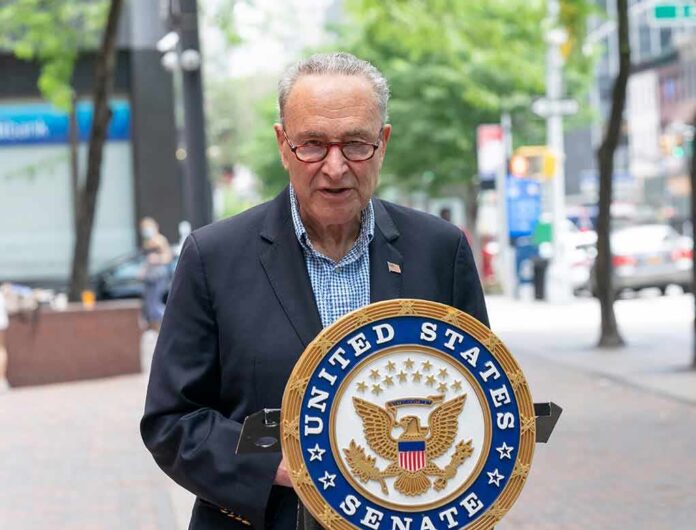
Chuck Schumer vowed “blue Mississippi is here, and the rest of the South will follow,” signaling a coast-to-coast push to flip red states starting with a razor-thin upset.
Story Snapshot
- Schumer said the South will “follow” Mississippi after Democrat Scott Colom’s narrow win.
- Colom defeated Republican Cindy Hyde-Smith by about 5,000 votes in a historic upset.
- National Democrats poured late money into the Mississippi race, including a Schumer-linked fund.
- Colom urged more spending to repeat results, not a one-off shock.
Schumer’s Claim Of A Blue South After Mississippi Flip
Senate Democratic leader Chuck Schumer declared, “blue Mississippi is here, and the rest of the South will follow soon enough,” after Democrat Scott Colom’s upset win. Schumer said Colom “shattered” what people thought Democrats could do in the South, tying a single state flip to a bigger regional push. His message was not subtle. He framed Mississippi as proof and a launchpad. That is a clear signal that national Democrats want to contest long-held Republican ground.
Republicans cannot ignore the loud claim. The promise targets conservative states with deep ties to faith, family, and the Constitution. It hints at a plan to import coastal policies on guns, speech, energy, and spending into communities that have fought those fights for years. The message is also meant to raise money and morale. It warns that Democrats see an opening and want to grow it fast. The question is how broad that opening is, and for how long.
What Actually Happened In Mississippi’s Razor-Thin Race
Democrat Scott Colom defeated Republican Senator Cindy Hyde-Smith in Mississippi, becoming the state’s first Black United States senator since Reconstruction. The Associated Press called the race on November 11, 2026. It was a surprise in a state that has backed Republicans for decades. National Public Radio’s results showed Colom at 49.4 percent and Hyde-Smith at 48.5 percent, a margin of about 5,000 votes. That tiny edge shows competitiveness, not yet a realignment.
Coverage described the win as a stunning upset, not a landslide. The margin matters. A race decided by under one point can swing on turnout, late ballots, and small shifts in a few counties. That means the Republican path back is clear if organization tightens and issues stay front and center. It also means Democrats need to pour in money and staff to hold ground. One close win does not make a state blue. It does, however, prove that Republicans must contest every vote.
Follow The Money: National Boost And Colom’s Own Advice
National attention and money rose fast once Democrats sensed a chance. A political action committee tied to Schumer reportedly dropped about $1.2 million into late advertising roughly two weeks before Election Day. That is not small change in Mississippi. Colom also told Politico that Democrats must invest more if they hope to win again, a frank admission that resources, not fate, drove the outcome. That tells Republicans something simple: organization and funding can swing close races.
Republicans should study where the money went, which messages landed, and which communities moved. Late air cover can matter, but ground game wins margins. County chairs, church networks, and local small-business voices can answer glossy ads with trusted facts. A sharper focus on inflation, border security, energy costs, and crime can connect policy to daily life. When Democrats stake a claim that the South will “follow,” the best answer is to outwork them where neighbors talk and votes are decided.
Why The Schumer Line Matters For The Next Two Years
Schumer’s line gives Republicans a clear rally point. It ties a narrow win to a wider goal, which voters in the South may see as an effort to rewrite local values from Washington. The line can also fire up conservative turnout, if used to show what is at stake for the Second Amendment, parental rights, and limits on federal power. The win was real, but it was small. The claim was big. That gap is where Republicans can press facts and results.
The path ahead is simple but not easy. Treat every Southern seat as competitive. Recruit strong, local voices who defend faith, family, and freedom. Link conservative policy to lower prices, safer towns, and secure borders. Match or beat Democrat spending with smarter, earlier outreach. Demand clear contrasts on guns, schools, policing, and debt. If Democrats want the South to “follow,” Republicans must lead with results and remind voters who stands with their values when it counts.
Sources:
redstate.com, apnews.com, politico.com, npr.org