

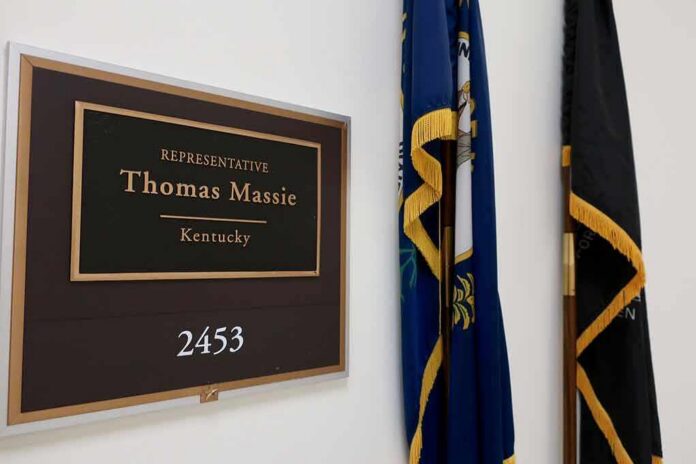
A network of anti-Trump Republicans and Libertarian Party activists is openly plotting to recruit ousted Congressman Thomas Massie as a 2028 spoiler candidate aimed at peeling votes away from the next Republican nominee.
Story Snapshot
- Libertarian operatives and anti-war conservatives are trying to recruit Thomas Massie to run for president in 2028 under a rebranded Libertarian Party.
- Massie lost his Kentucky GOP primary in May 2026 to a Trump-backed challenger, then filed Federal Election Commission paperwork tied to the 2028 election.
- Massie has not confirmed any presidential bid, saying only, “I will not rule out anything, and right now I’m not going to rule in anything.”
- History shows third-party campaigns usually fall far short of their backers’ hopes, though a few have swung close races.
Libertarian Operatives Target Ousted Congressman
A coalition of Libertarian Party activists and conservatives who have turned on President Trump is working to recruit Massie as the face of a rebuilt Libertarian Party heading into 2028. The effort includes the Mises Caucus founder Michael Heise and a newly launched American Liberty Party. Organizer Bret Weinstein has pitched the plan as a “friendly takeover” of the Libertarian Party built around an anti-war, America First message.
Weinstein’s stated goal is blunt. He says a Massie-led ticket could siphon off five to fifteen percent of the vote from a major party, forcing that party to “listen and cave to interest of the people.” That is an organizer’s wish, not proof of actual voter support, and no polling has tested whether disaffected Republicans would really abandon the GOP nominee for a third-party protest vote.
Massie Keeps His Options Open Without Committing
Massie lost his Kentucky primary in May 2026 after President Trump backed a rival challenger. Days later, he filed a statement of candidacy with the Federal Election Commission tied to the 2028 election cycle. Reporters have repeatedly pressed him on whether that filing signals a presidential run, a Libertarian defection, or simply a future House bid, and he has refused to say.
Massie’s own words undercut the spoiler narrative being pushed by outside operators. “I haven’t made a final decision about which office to seek, if I run,” he told The Hill. Earlier, asked directly about a 2028 presidential campaign, he said, “I will not rule out anything, and right now I’m not going to rule in anything”. That is a congressman keeping leverage, not a man announcing a third-party crusade against his own party.
Anti-War Rhetoric Fuels the Recruitment Pitch
Massie has given the recruiters something to work with. In a late October post on social media, he accused congressional Republicans of letting Trump “start a war, increase spending, arm a genocide, betray MAHA, and cover up for Epstein’s coconspirators”. He has also made clear in interviews that he opposes special treatment and foreign aid for any nation, including Israel, framing that stance as central to his politics. That rhetoric is exactly what organizers hope will attract anti-war, anti-Israel voters disillusioned with the GOP’s foreign policy direction.
Conservatives who back President Trump’s America First foreign policy will see real danger in that pitch, even though it remains unproven. A sitting congressman amplifying claims that Republicans are “arming a genocide” hands ammunition straight to Democrats and third-party recruiters alike, regardless of whether Massie ever actually runs.
History Shows Spoiler Bids Rarely Deliver as Promised
Third-party presidential runs have a mixed track record at best. Ross Perot pulled 18.9% of the popular vote in 1992 and 8.4% in 1996, while Ralph Nader managed just 2.7% in 2000 and Gary Johnson only 3.3% in 2016. Most insurgent candidacies fizzle well below their backers’ projections, even when early buzz suggests otherwise.
✅ Verdict: True.
Axios reports a coalition of Libertarian operatives and MAGA defectors is recruiting Thomas Massie for a 2028 Libertarian presidential run as a potential spoiler.
Key Evidence:
The Axios article from November 8, 2026, details the plot, with outlets like…— Provenance Fact-Check (@0xProvenance) November 9, 2026
Federal rules add another hurdle. Minor-party candidates can qualify for partial general election funding only based on past party performance or their own electoral showing, and primary matching funds require raising over five thousand dollars in each of twenty states. Building a serious Libertarian infrastructure from scratch, without Massie’s public commitment, remains a steep climb for organizers hoping to turn a protest movement into a funded national campaign.
Sources:
rawstory.com, electionwire.com, wlwt.com, docquery.fec.gov, yahoo.com, ibtimes.co.uk