
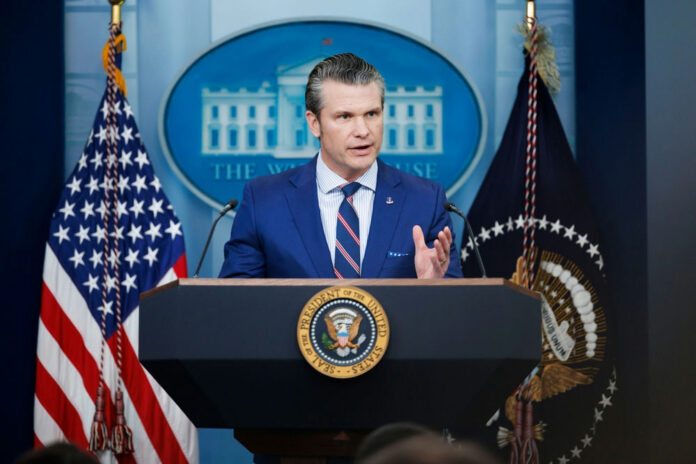
When the nation’s top defense official flies to Normandy with six of his kids in tow for solemn D‑Day ceremonies, it hits a raw nerve in a country already convinced that the political class plays by a very different set of rules.
Story Snapshot
- Pete Hegseth traveled to France on an official D-Day mission while arriving publicly with his wife and children.
- Critics say the scene made a taxpayer-funded war commemoration look like a family vacation.
- Supporters argue the trip followed government rules and that any family costs were privately covered.
- The fight reflects deeper distrust of political elites and blurred lines between public service and personal benefit.
How a D-Day Mission Turned Into a Family Travel Flashpoint
Video from a news report shows United States Defense Secretary Pete Hegseth landing at Orly Airport near Paris on June 5, 2026, “alongside his family” to attend D-Day commemorations.[1] The segment identifies his wife, Jennifer Rauchet, and their children arriving with him before official events marking the Allied invasion of Normandy during World War Two.[1] That imagery, coming at the start of a solemn government mission, fueled criticism that the trip blurred the line between official duty and a personal family excursion.
Government announcements and military media make clear that the France visit was an official assignment tied to the annual remembrance of the D-Day landings.[2] The War Department describes Hegseth traveling to the Normandy American Cemetery in Colleville-sur-Mer to commemorate the eighty-second anniversary of the Allied invasion and honor roughly one hundred sixty thousand troops who landed in 1944. A Defense Department video feed likewise frames the Normandy ceremony as a formal event led by the defense chief in his official capacity.[2]
Competing Claims: Misuse of Perks or Legitimate Mixed-Purpose Travel?
Critics argue that arriving with six children at a high-profile foreign ceremony made a serious, taxpayer-funded mission look like a family getaway.[1] They point to the optics of a cabinet-level official stepping off a government flight with his wife and children for commemorations usually associated with sacrifice, discipline, and national mourning.[1] In their view, that scene feeds a familiar pattern in which elites appear to attach personal benefits—comfort, access, or family travel—to trips regular citizens under financial stress could never afford.
Supporters counter that the trip itself was clearly official business, with any family component treated as a private expense under standard ethics rules.[2] They note that senior officials from both parties have long attended overseas memorials and sometimes travel with relatives, so long as personal costs are reimbursed.[2] From this perspective, Hegseth fulfilled his duties by representing the United States, delivering remarks, and meeting counterparts, while his family’s presence did not change the mission or its funding structure.
What Hegseth Said in Normandy and Why It Added Fuel to the Fire
Coverage of Hegseth’s D-Day remarks shows that he did more than lay wreaths and praise the fallen.[3][4] Reporting from the ceremony says he used the speech to link present-day immigration by sea to wartime liberation, warning Europe about what he described as an “invasion” of its coastline by migration.[3][4] That language echoed his longstanding political themes and the Trump administration’s focus on border threats, tying today’s debates over sovereignty and illegal immigration directly to the memory of Normandy.[3][4]
For critics already uneasy about the family travel, the speech reinforced a sense that a sacred anniversary was being folded into broader political messaging.[3][4] For supporters, the comments fit an “America First” outlook, using history to argue that Western leaders are again failing to defend their borders and values.[3][4] Either way, the combination of charged rhetoric, elite ceremony, and visible family presence fed public suspicion that Washington operates in its own insulated world, even at events meant to honor common soldiers’ sacrifice.
Why This Controversy Resonates Across Left and Right
This dispute follows a familiar pattern: high-ranking officials travel abroad for solemn occasions, and the fiercest arguments turn on optics and mixed-purpose travel rather than clear legal violations.[1][2] Questions arise when a trip is both highly visible and emotionally serious—war memorials, funerals, or disaster zones—because many citizens expect visible humility from leaders in those settings.[2] In that context, even a technically compliant family add-on can feel jarring when so many Americans are struggling with high prices, stagnant wages, and limited vacation time.
French Villagers just called Pete Hegseth “persona non grata” and demanded he stay home from D-Day ceremonies
Pete Hegseth made the trip to Normandy, France for the D-Day anniversary — but residents of Langrune-sur-Mer made clear he was not welcome. Locals and civic groups in… pic.twitter.com/wgKeIaGE7i
— #Anonymous (@TheStripesGirl) June 6, 2026
Both conservatives and liberals skeptical of the “deep state” see episodes like this as further proof that the political class enjoys privileges far beyond the reach of ordinary families. On the right, some view the controversy as media overreach targeting a Trump official while ignoring past abuses, yet still bristle at any hint of special treatment. On the left, many see one more example of officials using public roles to advance ideological agendas while remaining personally insulated from the consequences of policy failures at home.
Sources:
[1] Web – WaPo: Pete Hegseth Takes Six of His Kids Along on Official Visit to …
[2] YouTube – US Defense Secretary Pete Hegseth Arrives in France for Historic D …
[3] Web – Webcast – Hegseth Commemorates D-Day in France – DVIDS
[4] Web – Hegseth invokes immigration and ‘invasion’ in D-Day speech in France