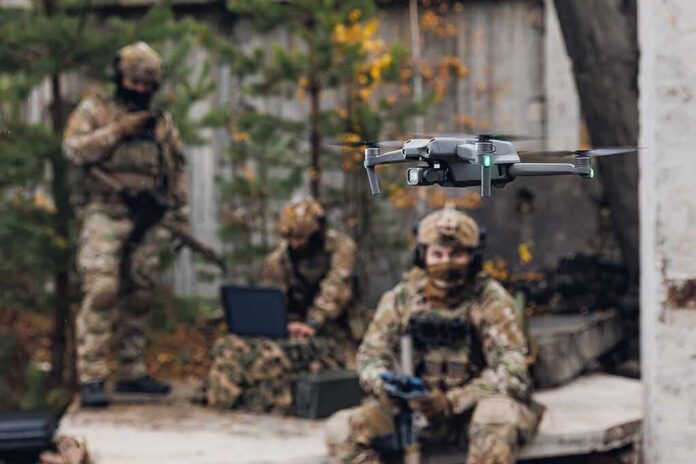
A recovered Russian Geran-4 jet-drone flight controller reportedly contained over 75% U.S.-company electronics, spotlighting a sanctions-evasion pipeline that threatens American security and industry competitiveness.
Story Highlights
- Ukrainian engineers catalogued 105 controller parts; at least 80 tie to U.S. companies.
- Texas Instruments and National Semiconductor parts made up 61 of the identified items.
- Investigators also observed Texas Instruments markings on recovered boards.
- Components from several Western nations and China show multi-country diversion routes.
What Investigators Found Inside the Geran-4 Controller
Ukrainian military engineers examined a recovered Geran-4 jet-drone flight controller and listed 105 electronic components. They linked at least 80 of those to U.S. companies, or about 76 percent of the identified set. The tally reflects markings and manufacturer lists found on the boards. The inventory provides a concrete look at how commercial electronics feed a Russian strike drone, even after years of sanctions tied to the war in Ukraine.
Texas Instruments and its acquired unit National Semiconductor reportedly supplied 61 of the 105 catalogued parts, or about 58 percent of the items listed in the controller analysis. A separate defense report said investigators saw Texas Instruments markings on the opened computer boards, reinforcing that at least some U.S.-company chips were physically present. The parts snapshot points to heavy reliance on American analog and power-management components that guide sensing, control, and power conversion.
Beyond One Brand: A Broad Mix of U.S. and Foreign Suppliers
The published table did not stop at one vendor. It linked parts to U.S. firms including Texas Instruments, onsemi, Analog Devices, Microchip, Monolithic Power Systems, Qorvo, Diodes Incorporated, CTS, Abracon, and more. Ukraine’s defence intelligence said the Geran-4 hardware draws from the United States, the United Kingdom, Germany, Switzerland, Japan, Taiwan, and China, with a Chinese transceiver also identified. That mix matches known diversion patterns where brokers route commercial chips through third countries.
These findings fit a wider pattern seen since 2022. Western-made commercial parts keep showing up in Russian weapons on the battlefield. Analysts describe how Russia leans on parallel imports, prewar stocks, and intermediary hubs to fill gaps. U.S. agencies have targeted covert procurement networks and warned businesses to harden screening and report suspicious orders, underscoring that the fight now centers on supply-chain choke points rather than factory floors.
Why It Matters for U.S. Security, Industry, and Enforcement
American-designed electronics inside an enemy drone raise two urgent issues. First, the parts boost a weapon that strikes civilian areas and critical sites in Ukraine. Second, the presence of U.S.-company technology—even when bought through intermediaries—risks normalizing a gray market that undercuts lawful firms and jobs at home. The government can tighten pressure on brokers and high-risk distributors while supporting companies that invest in stronger vetting and counterfeit detection.
The reports focus on one recovered controller, so the 76 percent figure applies to that examined unit, not to every Geran-4 or every subsystem. The evidence also does not claim that U.S. manufacturers knowingly sold into Russia’s drone program. Commercial parts can move through resellers and shell firms. That is why enforcement must trace lot codes, shipping paths, and suspicious buyers, and why companies should flag atypical orders and rerouting attempts at the first sign of risk.
What Comes Next: Practical Steps That Close the Back Door
Congress and the administration can back targeted actions that work. Investigators can request customs records, distributor invoices, and end-user statements to map true buyers and cut off fronts. Agencies can expand outreach to small and mid-size suppliers with clear red-flag guides and fast tip lines. Industry can tighten audits, verify resellers, and test suspect parts to spot relabeled or recycled chips before they ship. These steps protect national security and honest manufacturers without strangling trade.
Sources:
zerohedge.com, defenseromania.ro, militarnyi.com, twz.com