

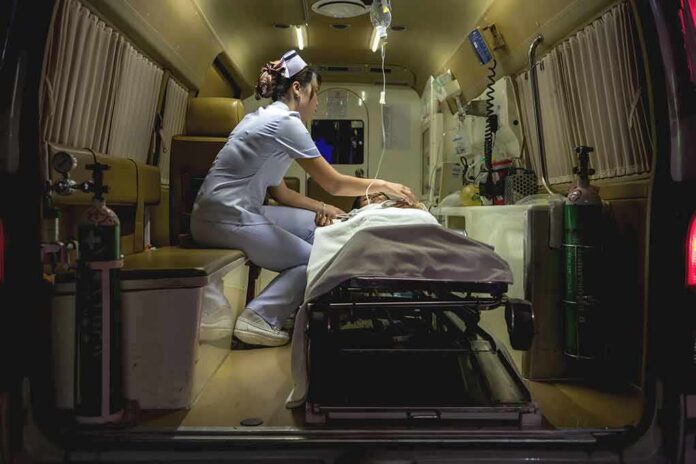
A 19-year-old says he “died” for about 15 minutes during a drug-related medical crisis and felt only a deep, empty sleep.
Story Highlights
- A teen describes 15 minutes without pulse as feeling like dreamless sleep.
- His brother performed chest compressions until paramedics arrived, who gave naloxone.
- He links the collapse to a stroke and aspiration, and is now in therapy.
- Doctors have long documented near-death reports among cardiac-arrest survivors.
Teen’s Account: “It Was Like a Deep Sleep”
The Mirror reports a 19-year-old collapsed at home and later said death felt “exactly like a deep sleep.” He claims he was out for about 15 minutes before responders brought back a faint pulse. He says there were no lights, no visions, and no feeling—just nothingness. He is now recovering and doing physical therapy. The outlet quotes his description of choking up black material and then aspirating into his lungs during the crisis.
The teenager says his brother, then 17, started chest compressions right away and kept going until medics arrived. Paramedics administered naloxone, a drug that can reverse opioid effects, and his pulse returned. He also says a stroke triggered the emergency, and that the aspiration worsened his condition. While he uses the word “died,” the report does not list a hospital name or doctor, but it does describe a clear rescue sequence and later rehab.
What We Know From the Reported Timeline
The Mirror’s story lays out a simple chain: sudden collapse, brother’s cardiopulmonary resuscitation, paramedics, naloxone, and a weak pulse returning. The teen puts the “dead” time at about 15 minutes, based on his memory of the event as told after recovery. The report emphasizes his core sensation—no dreams, no visions, no pain—only blank sleep. That calm, empty feeling contrasts with many popular near-death stories that feature vivid scenes or bright lights.
The medical narrative he gives mentions both stroke and drug exposure. He describes coughing up black material and aspirating into the lungs, which can deprive the body of oxygen fast. Oxygen loss can stop the heart and silence brain activity. That is why quick chest compressions and fast drug response matter so much. Early action kept blood moving, and a reversal drug can unblock a key cause when opioids are in play.
Near-Death Experiences in Medical Research
Near-death reports have been studied for decades. Prospective research has found that a notable share of cardiac-arrest survivors later report some form of near-death experience, often between roughly 12 percent and 18 percent in several cohorts. These studies document a mix of accounts, from peaceful dark to vivid light, from silence to sound, from calm to fear. The teen’s “dreamless sleep” report falls on the quiet end of that range.
Scholars also warn that terms like “near-death” and “clinical death” often get used loosely in public writing. Medical teams focus on what they can measure and treat: pulse, breathing, oxygen, and brain response. Cardiac arrest is the most studied point for these experiences, because the heart stops and patients are unresponsive while care teams work to restore circulation. Even then, people report very different inner states after they wake up.
Why This Matters for Families and First Responders
This story underscores two urgent truths. First, every second counts when a person collapses. Chest compressions can keep the brain alive until help arrives. Training teens and adults to do hands-only compressions can save lives in those first critical minutes. Second, rapid access to naloxone can turn the tide when drugs are involved. Households and community groups that carry it can bridge the gap before medics reach the scene.
For many readers, the teen’s report may offer comfort. He did not describe fear or pain. He described a quiet, blank sleep. Others may see a warning about risky drug exposure and delayed care. Both reactions point to a practical takeaway: learn how to respond. Know chest compressions. Call for help fast. Keep rescue tools handy if your community faces drug risks. These simple steps honor life and give medical teams a better chance to bring someone back.
Sources:
mirror.co.uk, teahouse.press, bernardokastrup.com