

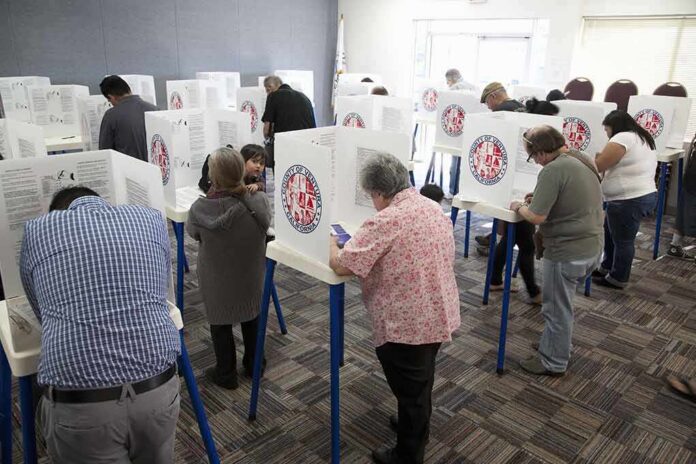
New voter data shows Democrats growing in diverse blocs, but Republicans under President Trump are breaking that “inevitable majority” narrative by winning more working-class and Latino voters.
Story Highlights
- Pew says the electorate is more diverse, but both parties remain near parity.
- Democrats counted on demographics, yet coalitions keep shifting with turnout and persuasion.
- Trump’s 2024 gains with Hispanic and some Black voters challenge “permanent majority” claims.
- Analysts warn one election does not prove a lasting realignment.
What the New Voter Landscape Actually Shows
Pew Research Center reported that registered voters today are 67 percent White, 13 percent Hispanic, 11 percent Black, and 4 percent Asian, reflecting a steady rise in diversity over three decades. Pew’s broader 2024 analysis found that these changes reshaped both party coalitions, yet the parties remain close to parity nationally. This means demographics alone do not settle elections. Turnout, issue salience, candidate quality, and geography still decide who wins key states and districts most years.
Progressive groups and some think tanks have long said growth in nonwhite voters would tilt the map blue, citing projections about Hispanic and Black voters expanding their shares in the electorate. But even these reports concede that registration, engagement, and turnout determine whether those groups convert potential into votes that count in swing states. The pattern remains clear: demographics can create a tailwind, but campaigns must still persuade and mobilize voters to capture it every cycle.
Why “Permanent Majority” Claims Keep Failing
History shows both sides overread big wins. After Democrats’ 2006 midterms and the 2008 Obama wave, some predicted a lasting blue era. Eight years later, Trump won the White House, powered by white working-class shifts and turnout changes that cracked the old map. Analysts at Third Way also cautioned Democrats against assuming demographics would deliver power, calling that belief a set of “illusions” not backed by voter behavior over time. Voters move when issues, costs, and trust change.
Pew’s data reinforces this view. Coalition composition evolves, but the two parties remain highly competitive as new divides replace old ones. A detailed election cycle still hinges on who shows up and what issues matter that year. Gas prices, border security, crime, and school standards can reorder priorities fast. That is why predictions of a locked-in Democratic era have not matched election outcomes across the last two decades. Durable majorities require performance, not promises.
Trump’s 2024 Coalition Upset the Narrative
Trump’s 2024 win tested the “demographics decide” thesis. He improved with Hispanic voters and made gains with some Black voters, while lifting Republican support in many states compared to 2020, including urban and suburban areas at the margins. The Denver Gazette reported he outperformed his 2020 numbers in 49 states and won the national popular vote for Republicans for the first time in 20 years, signaling a broader reach than many expected. That performance cracked the myth of a one-way demographic glide path.
That's how it's always been in California. It's not fraud, it's procedure. Especially considering that California has a meticulous VERIFICATION PROCESS and the largest population in the country.
And by the way, Trump himself votes by mail FFS, and so do citizens in nearly every… https://t.co/BhIPDynaDf
— Eric Jay (@EricinAmericaX) August 19, 2026
Scholars caution that one strong cycle does not prove a permanent realignment. A 2026 research note on Latino voters argued that durability needs repeated elections and stable issue alignments to be established. Still, the 2024 map showed that culturally grounded messages on jobs, border enforcement, energy costs, and safe streets can earn support across lines that pundits once called fixed. That is a roadmap for Republicans under President Trump to keep pressing in diverse, working-class communities.
What Conservatives Should Watch Next
Republicans should measure progress by turnout and persuasion among working families, not by assuming momentum will last on its own. Pew’s coalition work suggests both parties can gain or lose ground quickly as issues change and as trust in institutions rises or falls. President Trump’s agenda on secure borders, cheaper energy, parental rights, and safer neighborhoods speaks to daily life. If results keep matching promises, those voters are likely to return. If not, the map can shift again just as fast.
Democrats will keep counting on demographic change to bail them out. The data says they still must persuade, register, and mobilize voters cycle after cycle. Conservatives should not fear population trends, but should compete for every vote with common sense and results. Faith, family, work, safe communities, and an accountable government cross every background. When Republicans fight inflation, stop illegal immigration, and defend constitutional rights, they prove there is no such thing as a “permanent” Democratic majority.
Sources:
theamericanconservative.com, brookings.edu, nationalaffairs.com, americanprogress.org, theweek.com, utne.com, ipa.org.au, denvergazette.com, sites.tufts.edu, nytimes.com, pewresearch.org, fs.wp.odu.edu