
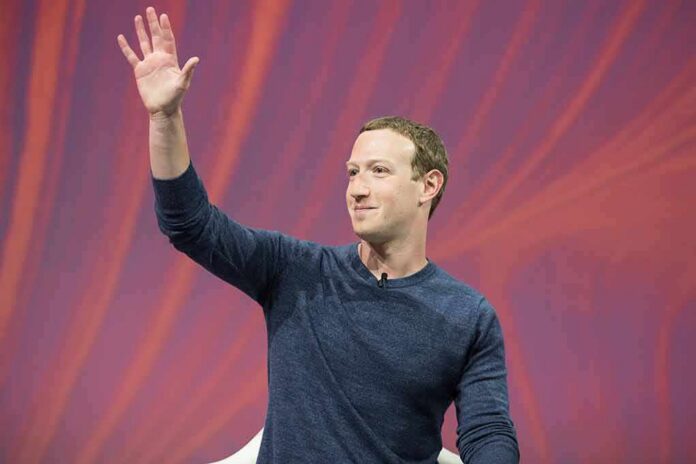
Mark Zuckerberg said tech leaders drafted the White House AI pledge, and President Trump released it as official policy guidance after a high-profile meeting.
Story Highlights
- Zuckerberg said companies drafted the accord’s safety commitments.
- SemaFor reported Zuckerberg circulated a draft before the White House meeting.
- President Trump and top AI chiefs signed a voluntary pledge at the White House.
- The accord calls for robust internal controls and outside audits of powerful models.
What Was Signed At The White House
President Trump announced a voluntary AI safety accord after a White House meeting with the chiefs of Meta, Google, OpenAI, Anthropic, X, and NVIDIA. Reporting says Trump released the accord publicly, underscoring that it is an official White House framework rather than a private side deal. The document sets out self-policing steps for companies that build the most advanced systems. The pledge is described as “morally binding,” not a law, which places it in the voluntary category common in tech policy.
Reuters said the accord carries President Trump’s signature alongside major company leaders. That signals buy-in at the highest level and a shared desire to shape responsible development while keeping innovation moving. The reported signatories include Meta’s Mark Zuckerberg, who attended the meeting and stood with other executives for post-event remarks. The White House push reflects an approach that favors industry-led standards over heavy federal mandates, aligning with limited-government principles and American competitiveness.
Zuckerberg’s Role In Drafting The Pledge
SemaFor reported that Zuckerberg circulated a draft of the agreement ahead of the White House session, shaping the language the group later adopted. After the meeting, Zuckerberg told reporters that “we drafted a set of principles and commitments” focused on robust internal controls and problem detection, which matches the pledge’s safety language described by multiple outlets. Those facts show direct company involvement in the text. The available reporting does not break down who wrote which clause, but it places Zuckerberg in an active drafting role.
Reporters also linked Zuckerberg’s remarks to specific features in the accord, including internal reviews, board-level oversight, and the use of outside auditors to test controls on high-risk models. Those steps track with how large firms manage financial or security risks. By promoting auditing and layered reviews, the accord aims to prevent runaway behavior while models are trained, tested, and deployed. That structure gives companies room to innovate while committing to checks that can be explained to customers, investors, and the public.
What The Accord Actually Requires
Coverage of the accord highlights several concrete expectations. Companies commit to build strong internal controls to track powerful model capabilities. They agree to bring in independent auditors to evaluate those controls. They plan to have board-level committees review the results and hold management responsible for fixes when needed. These steps are familiar from other risk-heavy fields. They do not create new federal penalties, but they do set public standards that firms can be judged against in the market.
Guardrails for AI, Greenlight for Data Centres: Trump and AI CEOs Agree to Voluntary Safety Standards; Firms Pledge Independent Audits of Systems
The Agreement
US President Donald Trump said on Tuesday that tech executives agreed to establish voluntary AI standards, while he… pic.twitter.com/sTxA4fmFGh— The Cloaked Gaze 👀 (@gaze_observer) October 1, 2026
Analysts note that industry favors voluntary frameworks because they allow quick updates as technology moves. The Trump administration’s release of the accord places the White House behind this approach while avoiding sweeping new bureaucracy. Supporters say that keeps the United States fast and competitive. Critics of heavy-handed regulation argue that red tape would push jobs and data centers overseas, raise energy use costs, and slow breakthroughs that help families and small businesses thrive.
Why It Matters For Conservatives
Conservatives want safety without surrendering freedom or growth. This accord fits that lane. It sets guardrails that companies themselves implement and fund. It avoids a new federal speech board or intrusive monitoring regime. It aims to keep high-powered systems from harming critical infrastructure, while letting American builders outpace China and Europe. President Trump secured public commitments from leaders who control this technology, and he put their promises on the record for voters and markets to see.
One limitation deserves a clear note: reporting confirms company drafting and a circulated pre-meeting draft, but not a line-by-line authorship map across White House staff and all executives. That does not change the core facts. Zuckerberg said the companies drafted the principles, the content of the pledge reflects those terms, and President Trump released the accord as an official White House framework. The result is a self-regulatory model that backs American strength and individual liberty over one-size-fits-all rules.
Sources:
feedpress.me, siliconreport.com, afp.com, foxnews.com, cnn.com