

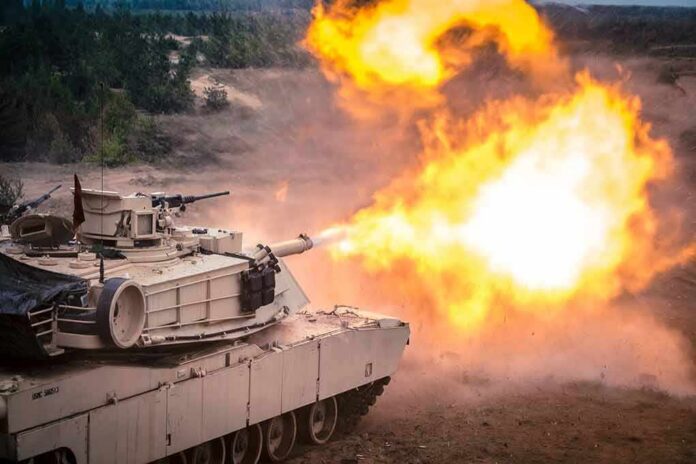
After spending hundreds of millions on a handful of prototype upgrades, the U.S. Army shut down the M1A2 Abrams SEPv4 and pivoted to a new M1E3 tank built to be lighter, modular, and easier to sustain.
Story Snapshot
- The Army ended the M1A2 SEPv4 upgrade and chose the new M1E3 path.
- Rising weight and logistics burdens made SEPv4 a dead end for mobility.
- M1E3 will keep the best SEPv4 features but on a cleaner, modular design.
- Congressional and testing documents confirm the formal shift to M1E3.
Army Cancels SEPv4, Commits to M1E3 Modernization
Army leaders announced in September 2023 that they would close out the M1A2 System Enhancement Package version 4 and develop the M1E3 Abrams instead. The decision marked a reset after years of bolt-on upgrades that pushed the tank toward weight and power limits. The Director, Operational Test and Evaluation report for fiscal year 2023 also recorded the change, underscoring that the service formally ended SEPv4 to start a new modernization track. Officials framed the move as necessary to improve survivability, mobility, and sustainment for future fights.
Congressional researchers summarized the Army’s rationale as a shift to a modular open-systems architecture that can adopt new tech faster and at lower cost. Leaders said the M1E3 would carry forward the best sensors and fire-control technology planned for SEPv4, but on a lighter, more adaptable baseline. This approach aims to curb the “Christmas tree” problem, where add-ons pile up until the platform becomes too heavy and complex. The Army wants simpler integration, easier maintenance, and faster upgrades across a long service life.
Weight, Mobility, and Logistics Drove the Break
Service officials tied the pivot to severe mobility and logistics concerns caused by rising weight under SEPv4, including bridge limits and tactical movement issues. Reporting at the time detailed how the tank’s mass trend risked strategic mobility, resupply demands, and transport constraints—areas that matter in any high-tempo conflict. By stepping back to redesign the baseline, the Army seeks to integrate protection and sensors without pushing the Abrams into the 70-plus ton trap that strains fuel, tracks, and transport. That calculus shaped the choice for M1E3.
Analysts who tracked the program described SEPv4 as an impressive package on paper that still faced real-world tradeoffs as weight rose. They noted the Army’s pattern of ending incremental paths once size, weight, and power limits reduce growth room and increase costs. Those concerns met rising threats from drones and long-range weapons that demand faster upgrades and cleaner integration. The new plan aims to solve these problems by designing for change from the start, not by stacking more gear onto an aging frame.
What the Shift Means for Troops, Industry, and Taxpayers
For soldiers, the promise is a tank that is easier to move, protect, and repair in the field. For industry, the message is clear: build to open standards so components swap in without major rewiring. For taxpayers, the reset recognizes that chasing ever-heavier “solutions” can waste money and risk readiness. Independent coverage documented the Army’s formal approval of the M1E3 engineering change plan in the fiscal year 2026 acquisition program, locking in the new direction and canceling the previous upgrade track.
For conservative readers, the lesson is accountability. The Army directed resources away from a path that no longer made sense and toward a design that respects logistics, budget limits, and warfighter needs. Congressional and test documents verify the pivot and the reasons behind it. The next test is execution: keep weight down, keep the architecture open, and deliver combat power without creating another maintenance monster. A lighter, modular Abrams can strengthen deterrence without draining the treasury.
Key Unknowns and Next Steps
Program officials have not published final M1E3 specifications, production timelines, or unit fielding schedules in one public source. That leaves open questions on exact weight targets, powertrain choices, and how quickly units will convert. What is clear is the design intent: reduce the logistical footprint while preserving and integrating the best SEPv4 sensor and fire-control gains. As testing advances, the Army will need to show real improvements in mobility, protection integration, and sustainment costs compared to late-model Abrams.
President Trump’s administration now oversees the delivery phase. Voters should watch how leaders balance speed with discipline. The goal is sharp: field a tougher tank that moves faster, drinks less fuel, and accepts upgrades like a smartphone, not a science project. If the Army holds that line, America’s armor stays lethal and ready without the dead weight. If not, Congress and the public should demand a course correction before dollars and time are lost.
Sources:
19fortyfive.com, defensenews.com, lenta.ru, dote.osd.mil