

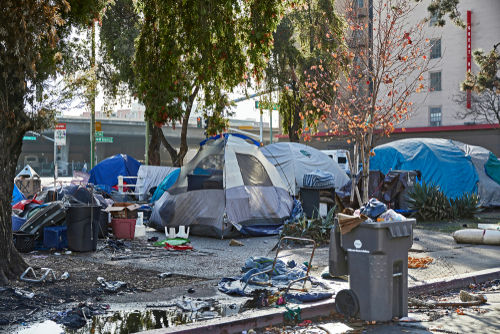
A staged “encampment” outside Nithya Raman’s lakeview home turned a policy fight into street theater that now tests where advocacy ends and harassment begins.
Story Snapshot
- The organizer called the display political satire tied to Raman’s homelessness record, not a prank [5].
- Raman condemned the stunt as crossing into personal space and affecting her family [2].
- The debate sharpened contrasts aired in the recent mayoral face-offs over homelessness policy [3].
- The facts about intent, funding, and location permissions remain thin and contested [5].
Satire on the sidewalk, or intimidation at the doorstep
Fox 11 Los Angeles aired footage of tents, trash, and props outside Nithya Raman’s home, along with a masked organizer saying the setup was “basically doing a parody ad for her,” expressly linking it to perceived failures on homelessness in her Council District 4 record [5]. He denied coordination with rival Spencer Pratt’s campaign and claimed donor support through a network related to Safe Cities USA, a statement asserted on camera without producing corroborating documents [5]. That anonymity leaves attribution—and accountability—unsettled.
Nithya Raman and her campaign framed the stunt as a violation of personal boundaries, citing the impact on her young children and describing the tactic as beyond acceptable campaign conduct [2]. That reaction tracks with a broader civic fatigue around political escalations at private homes, where critics argue the venue transforms a policy critique into coercive spectacle. The public has little patience for tactics that resemble doxxing theater, even when participants invoke satire. Voters often split the baby: message received, method rejected.
Policy backdrop: what Raman runs on, what critics say
Raman has positioned herself as a housing-first reformer, highlighting work on outreach, interim placements, and city coordination in her council district’s homelessness effort pages [1]. Her mayoral platform and debate performances emphasize faster housing production and stronger oversight of service systems, placing responsibility on capacity and coordination rather than on punitive sweeps [2][3]. The organizer’s critique alleges the on-the-ground reality undercuts that narrative. The problem for the critic: a stunt can spotlight a grievance but cannot substitute for data about encampment trends, placements, or outcomes.
American conservative instincts emphasize accountability, clarity of results, and the primacy of order. If a candidate brands themselves as a homelessness problem-solver, neighborhoods reasonably expect visible reductions in street disorder and encampments. However, the stunt’s representational accuracy is not established in the record. Without contemporaneous district data or verified visual comparisons, the staged scene risks caricature. A pointed question remains fair: are cleaner blocks, fewer tents, and safer parks materializing in District 4? Voters should demand hard metrics, not just imagery or slogans.
The ethics hinge: intent, funding, location, and consent
The organizer’s stated goal—satire aimed at a public official’s policy record—sits within protected political speech. The unresolved questions are practical: where exactly the display was staged, under what permissions, and who paid for it. Those factors determine whether the act reads as lawful advocacy or as trespass and targeted harassment. The claim of donor backing through a network associated with Safe Cities USA lacks third-party confirmation in the available reporting [5]. That gap feeds suspicion from opponents and undermines the organizer’s credibility advantage in a close race.
Nithya Raman, she’s a LA City Councilmember running for mayor. A group staged a fake homeless encampment right outside her house in the hills of Silver Lake as political theater.
They set up props and actors in her driveway, filmed it to look chaotic, and pushed the videos… pic.twitter.com/JSPkXWdKsv
— Patricia 🇺🇸 (@1109Patricia) May 29, 2026
Campaign-season escalation tends to boomerang. If the public hears “kids at home” louder than “policy satire,” the tactic erodes sympathy for the critic and fortifies the candidate’s narrative about extremism. If, however, the staged encampment drives media scrutiny into district-level homelessness outcomes, the gambit could pressure Raman for granular performance data: how many beds added, how many placements retained, how many encampments resolved without return. That is the terrain where rhetoric dies and results decide.
What voters should watch next
Three verifications would move this story from theater to substance. First, proof of funding sources and vendors would clarify whether this was independent advocacy or a shadow extension of a campaign [5]. Second, location and permit records would resolve the line between legal expression and unlawful intrusion. Third, district metrics—encampment counts, time-to-placement, sanitation cycles, and post-clearance recurrence—would reveal whether Raman’s approach is working at the block level [1][2]. Until those arrive, both sides talk past each other while Angelenos still step around tents.
Sources:
[1] Web – Savage: One Advocacy Group’s Viral Campaign Delivers Homelessness to …
[2] Web – Homelessness | Los Angeles City Councilmember 4th District
[3] Web – Raman on homelessness – LAist
[5] YouTube – Fake homeless encampment stunt outside Nithya Raman’s home …