

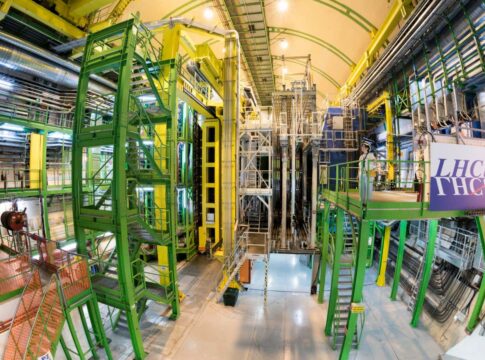
Physicists at CERN’s Large Hadron Collider have identified a new particle containing two charm quarks, ending a decades-long search for this heavier cousin of the proton that exists for only a fraction of a second before decaying.
Understanding the Discovery
The particle belongs to a class called baryons, which includes protons and neutrons. While regular protons contain two up quarks and one down quark, this newly discovered particle contains charm quarks, which are significantly heavier. The LHCb experiment team spotted the particle despite its extremely short lifetime, which makes detection difficult. These unstable combinations decay almost instantly into other particles, requiring precise measurement equipment to confirm their existence.
Scientists believe the discovery will help them understand how the strong nuclear force binds together heavier quarks compared to those found in common protons and neutrons. This force is one of the four fundamental forces in nature, governing how quarks stick together to form larger particles. The finding addresses questions that physicists have pursued since the early 2000s about whether such particle combinations could exist and remain stable enough to detect.
Scientific Implications and Challenges
Juan Rojo, a physicist at Vrije University Amsterdam, noted that while the discovery confirms the particle’s existence, current theories struggle to predict how heavier quarks interact within baryons or what their masses should be. The measurement puts experimental data ahead of theoretical predictions for these types of particles. Rojo suggested that within five years, this discovery could help answer fundamental questions about how different quark combinations affect particle masses and behavior.
The Path Forward
The Large Hadron Collider, located near Geneva, Switzerland, remains the world’s most powerful particle accelerator. This facility enables scientists to recreate conditions similar to those moments after the Big Bang, allowing them to observe particles that existed in the early universe but rarely appear in nature today. The discovery demonstrates the continued value of high-energy physics research in expanding our understanding of matter’s fundamental building blocks and the forces that govern them.