

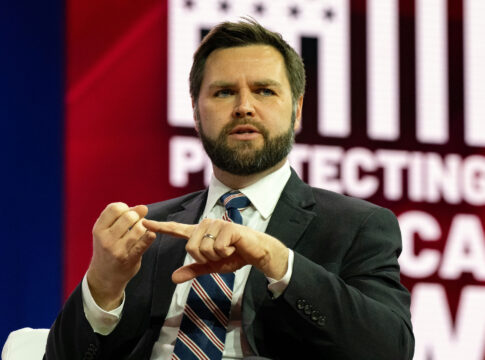
Even after a full federal probe, America still doesn’t know why a 20-year-old got within seconds of assassinating Donald Trump—and JD Vance is now saying so out loud.
Vance’s admission matches the FBI’s bottom line
Vice President JD Vance has publicly acknowledged he does not know why Thomas Matthew Crooks tried to kill Donald Trump at the July 13, 2024 rally near Butler, Pennsylvania. That statement is politically striking, but it is also consistent with the federal government’s official endpoint: the FBI concluded its investigation in November 2025 and determined Crooks acted alone, with no clear motive established from the available evidence.
Reports framing Vance’s comments as a reversal depend on what he previously implied about solving the mystery, and the research available here does not provide direct quotations or full context of those earlier remarks. What can be said with confidence is that Vance’s current position aligns with the FBI’s conclusion: investigators did not present the public with a definitive “why,” even after extensive review of Crooks’s actions, searches, and preparations.
What the public record shows about the attack timeline
The attack itself has a well-documented timeline. Crooks, 20, fired eight rounds from an AR-15–style rifle from a nearby building’s roof, grazing Trump’s upper right ear. One rally attendee was killed and two others were critically injured before the Secret Service Counter Sniper Team fatally shot Crooks. Those facts matter because they show the incident was not a vague threat—it was a near-miss with casualties and lasting national consequences.
Investigators and later reporting also outline preparation steps that complicate any simplistic narrative. Crooks visited the rally site on July 7 and registered to attend on July 11. On July 12, he practiced with his rifle at a shooting range. On the day of the shooting, he purchased ammunition, arrived mid-afternoon, and had an explosive device in his car trunk. About 11 minutes before the shots, he flew a drone over the rally area.
Security warnings before the shots remain the most unsettling detail
The most troubling portion of the record is that multiple local law enforcement officers reportedly spotted Crooks 20 to 30 minutes before the shooting and regarded him as suspicious near the magnetometer area. The Secret Service was informed, yet Crooks stayed outside the security perimeter and did not go through screening. Roughly 40 seconds before he opened fire, he aimed his rifle at a Butler Township police officer trying to climb up, causing the officer to fall and be seriously injured.
Those details do not prove intent by any agency, but they do highlight the kind of practical failure that frustrates the public: warnings were present, time existed to act, and the perimeter still allowed a rooftop firing position. For Americans who have watched years of expanding bureaucracy, the case reads like a lesson in why “more government” does not automatically mean better protection—especially when coordination across jurisdictions breaks down.
Why motive matters for prevention—and why it may stay unresolved
When the government cannot explain motive, it becomes harder to build prevention models that the public can trust. The FBI reportedly found that Crooks searched for information about major depressive disorder months before the attack, though no diagnosis was confirmed, and that he searched “how far was Oswald away from Kennedy” days before the rally. Explosives were also found at Crooks’s home and in his vehicle, reinforcing that the threat was serious and premeditated.
At the same time, the research here indicates investigators still could not establish a clear motive. That gap leaves room for speculation, but speculation is not evidence. The responsible takeaway is narrower: if the official conclusion is “acted alone” and “no clear motive,” then the next best safeguard is tightening protective operations, clarifying who owns the perimeter, and ensuring rapid escalation when a suspicious person is flagged near a high-profile event.
The political aftershock: campaigning, confidence, and accountability
After the assassination attempt, Trump’s campaign announced plans to resume rallies, including a major event in Grand Rapids, Michigan. The return to public events signaled resolve, but it also kept the security debate in the spotlight. Vance’s admission, whether viewed as candor or as an unsatisfying non-answer, lands in a country that has grown skeptical of official narratives after years of institutional missteps and partisan spin.
Limited public detail about the exact context and timing of Vance’s remarks also makes it difficult to judge claims that he contradicted prior promises. What is clear is that the most authoritative available conclusion remains the FBI’s: no clear motive established. For citizens who care about constitutional stability and basic governmental competence, the priority is not a media “gotcha,” but transparent accountability—so the next warning sign near a presidential stage does not get lost in the cracks.
Sources:
Attempted assassination of Donald Trump in Pennsylvania
JD Vance makes jaw-dropping admission on Trump shooter Thomas Crooks
Live updates: Donald Trump rally shooting; Trump Jr says father is changed man
The Democrats knew, and prob paid his family to have this done. The fact that CNN hardly ever covered
Trumps campaign events with cameras of their own, but at this event they arrived with a “slow mo” camera, well, that should tell you something. Anyone who thinks the Democrat party did not want Trump
dead is clueless as to how evil the democrat party really is.