

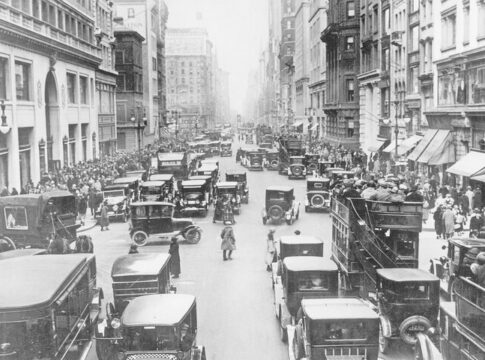
Imagine stepping into a time machine and dialing the year back to 1925. You would arrive in the middle of the “Roaring Twenties,” a time when the United States was changing faster than ever before. Horse-drawn carriages were fighting for space with shiny new Model T Fords, and skylines were just beginning to stretch toward the clouds.
State capitals were the heartbeat of this change. They were not just centers of government; they were snapshots of a nation trying to decide if it wanted to be rural or urban, old-fashioned or modern. Let’s take a tour of six major capitals to see what life looked like a century ago.
Boston, Massachusetts: The Old City Meets the New Era
In 1925, Boston was a city where history and modern life were crashing into each other. The narrow, winding streets, laid out in colonial times, were suddenly clogged with automobiles and electric streetcars. The city was dense and bustling, with the historic Massachusetts State House sitting high on Beacon Hill like a golden crown.
But the skyline was changing. Early skyscrapers were starting to rise above the church steeples, signaling Boston’s role as a major commercial hub. The port was alive with activity, but the city was struggling to fit a modern population into a layout designed for walkers and horses. It was a chaotic, vibrant mix of the 18th and 20th centuries.
Indianapolis, Indiana: The Crossroads of America
Head out to the Midwest, and you would find Indianapolis in the middle of a massive transformation. By 1925, the city was truly earning its nickname as the “Crossroads of America.” The downtown area was expanding rapidly, centered around the Soldiers and Sailors Monument, which had become the city’s iconic anchor.
The streets here were wide and laid out in a logical grid, a stark contrast to Boston’s tangles. You would see the influence of the booming auto industry everywhere, with cars dominating the roads more than in many older eastern cities. It was a city that felt spacious, ambitious, and ready to drive straight into the future.
Oklahoma City, Oklahoma: The Instant Metropolis
If you wanted to see pure, raw energy in 1925, you went to Oklahoma City. Just a few decades earlier, this land had been open prairie; now, it was a booming metropolis fueled by oil. “Black gold” had been discovered nearby, and the wealth was literally erupting from the ground.
The city felt brand new because it was. There were oil derricks visible right within the city limits, sometimes even on the lawn of the Capitol building itself. Skyscrapers were going up at a breakneck pace to house oil companies and banks. It was a rough, exciting place where fortunes were made overnight, and the dust of the frontier was being paved over with asphalt.
Harrisburg, Pennsylvania: Industry and Elegance
Harrisburg in 1925 offered a view of America’s industrial might. The city was defined by the Susquehanna River, which was spanned by grand bridges connecting the capital to the rest of the state. Smoke from steel mills and factories drifted over the river, a sign of the powerful industrial economy that drove the region.
But amidst the industry, there was beauty. The State Capitol complex was a masterpiece of the “City Beautiful” movement, designed to inspire pride and order. The grand dome of the Capitol rose high above the factory smokestacks, a symbolic reminder that government and industry were the twin pillars of society.
Carson City, Nevada: The Frontier Outpost
Stepping into Carson City in 1925 would feel like walking onto a movie set. While other capitals were building skyscrapers, Carson City still felt like a small frontier town. It had the smallest population of any state capital, and the streets were quiet compared to the chaos of the East.
The architecture was simple and rugged, reflecting its mining heritage rather than big-city banking. It was a place where the desert felt close, and the wild, open West was just at the end of the street. It was a capital city that still wore its cowboy boots.
Augusta, Maine: The Mill Town Capital
Far to the northeast, Augusta, Maine, presented a completely different picture. It was a compact city where the business of government happened right alongside the business of making things. The skyline wasn’t dominated by office towers, but by the brick chimneys of riverside textile and paper mills.
The Kennebec River rushed through the heart of town, powering the factories that employed many residents. The State House looked down over a city that was hardworking and modest. In 1925, Augusta was the perfect example of a working-class capital, where the governor and the mill worker shared the same small, snowy streets.
A Nation in Transition
Looking back at these six cities, we see more than just old buildings and vintage cars. We see a country in the middle of an identity crisis. From the oil boom of the West to the factories of the East, the United States in 1925 was a patchwork of different worlds, all moving toward the modern era at their own speed.