

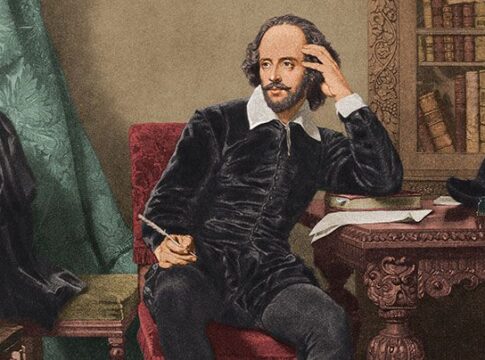
William Shakespeare is often called the greatest writer in English, but his legendary status grew after his death. During his lifetime, he was respected and successful within London’s theater and literary circles, yet he was one of several talented playwrights rather than a universal icon. His works drew attention, and certain poems and plays were quite popular, but Shakespeare was best known to those who attended the theater or followed London’s literary scene. Fame in Elizabethan England was local, and public recognition relied on patronage, print culture, and word of mouth.
Life and Career in Context
Shakespeare was born in 1564 in Stratford-upon-Avon, a market town in England. He moved to London in the early 1590s, joining the theater world as a playwright, actor, and shareholder in the Lord Chamberlain’s Men.
The Elizabethan era supported artistic growth, with monarchs like Elizabeth I and James I encouraging theater. London’s expanding population and economy created a thriving audience for plays, giving Shakespeare a platform to build his reputation.
Works and Popularity
Shakespeare achieved early success with poems such as Venus and Adonis, which were widely read and praised. His plays, performed at theaters in London, attracted diverse audiences, from nobles to commoners.
Despite this recognition, he was one of several popular writers, alongside peers like Christopher Marlowe and Ben Jonson. His fame was significant within his professional circle, but he was not yet the global literary icon later generations would celebrate.
The Role of Patrons and Publishers
Royal and noble patronage was essential for Shakespeare’s career, helping secure performances and printed editions of his work. Publishers and printers circulated his poems and plays, increasing his visibility among literate audiences.
Theaters and companies, including the Lord Chamberlain’s Men, competed for audiences, influencing which playwrights were performed and promoted. Shakespeare’s success was closely tied to this system of patronage and professional networks.
Comparing Contemporary and Posthumous Fame
In his lifetime, Shakespeare was respected, admired, and commercially successful, but his reputation remained largely confined to London. His contemporaries recognized his talent but did not elevate him above all other writers of the day.
After his death in 1616, however, his works were collected, studied, and celebrated by later generations. By the Romantic era, Shakespeare’s genius was universally acclaimed, transforming him from a respected playwright into an enduring cultural legend.
Impact on Literature and Society
Shakespeare’s plays and poems helped professionalize acting and shape English drama, influencing theater practices and storytelling for centuries. He also reflected social attitudes, class dynamics, and political ideas of his time, offering insights into Elizabethan culture.
His approach to character, dialogue, and plot set a standard that inspired countless writers. Even though his legendary fame came posthumously, his works’ impact was immediate and lasting in shaping English literature.
Lessons from Shakespeare’s Fame
Shakespeare’s career demonstrates that contemporary recognition does not always predict historical legacy. He was successful in his lifetime, but his ultimate reputation depended on the preservation, study, and admiration of later generations.
His story also shows that talent, opportunity, and the support of patrons and audiences are intertwined. Shakespeare’s rise from a local playwright to a timeless cultural figure reminds us that fame evolves over time and is often shaped by history itself.