

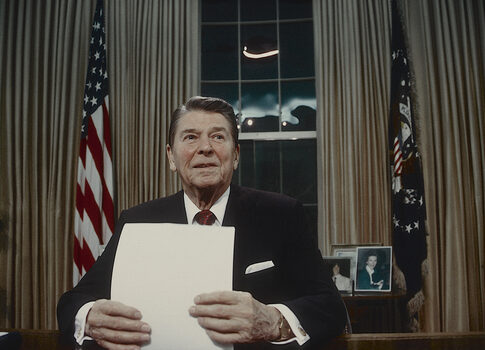
The title “Commander in Chief” is one of the most powerful and consequential roles of the U.S. presidency. It’s the phrase that immediately signals civilian supremacy over the armed forces, placing the ultimate authority for the military in the hands of an elected leader.
But where did this title come from, and why is it so important? The role is rooted in a deep historical distrust of military power and a careful constitutional design intended to prevent a military dictatorship.
The Constitutional Mandate
The title is not merely ceremonial; it is explicitly defined in Article II, Section 2 of the U.S. Constitution:
“The President shall be Commander in Chief of the Army and Navy of the United States, and of the militia of the several states, when called into the actual service of the United States…”
This single sentence makes the President the supreme operational head of the military. Critically, it gives the president three distinct, intertwined authorities that shape the balance of power in government:
1. Ensuring Civilian Supremacy
The founders of the United States were deeply skeptical of powerful, independent armies—a view heavily influenced by their experiences with the British monarchy. They ensured that the person commanding the military must be an elected civilian leader, not a general.
By vesting this power in the President, who is accountable to the public and subject to regular elections, the Constitution guarantees that military power remains subordinate to democratic rule, a foundational principle of the American republic.
2. The Efficiency of a Single Executive
The government created under the earlier Articles of Confederation was too fragmented, making wartime decisions slow and ineffective. The Constitutional Convention of 1787 recognized that military operations require speed, secrecy, and unified command.
By placing command authority in a single executive, the founders created an efficient, singular decision-maker who could respond rapidly to threats, ensuring the nation’s survival without sacrificing the overall principle of civilian control.
3. Borrowed from History
The concept wasn’t invented from scratch. It has historical roots dating back to the Roman emperors, who held supreme executive and military authority (imperium). Closer to home, the title was used in the English tradition, where the King was the Commander in Chief.
During the Revolutionary War, the Continental Congress named George Washington “General and Commander in Chief.” However, Washington was always subordinate to the Congress. The Constitution later formalized this tradition but shifted the title to the elected President, ensuring the ultimate authority resided in the civil government.
The System of Checks and Balances
While the President commands the military on a tactical and strategic level, that power is far from absolute. The Commander in Chief clause is constantly checked and balanced by the Legislative Branch:
- Congress Declares War: Only Congress has the power to formally declare war, as outlined in Article I, Section 8.
- Congress Funds the Military: Congress controls the budget, the size, and the composition of the armed forces through its power to “raise and support armies.”
- Senate Confirms Leaders: The President’s top military and diplomatic appointees must be confirmed by the Senate.
This deliberate division of powers often leads to political tension, especially in the modern era of rapid global threats where presidents frequently take military action without a formal declaration of war. Debates over the President’s war-making authority—and Congress’s efforts to reassert its oversight—remain central to U.S. constitutional law and civil-military relations today.
In the end, the title “Commander in Chief” embodies the fragile but essential balance between the need for decisive military action and the absolute requirement that the military must serve the democracy that created it.