
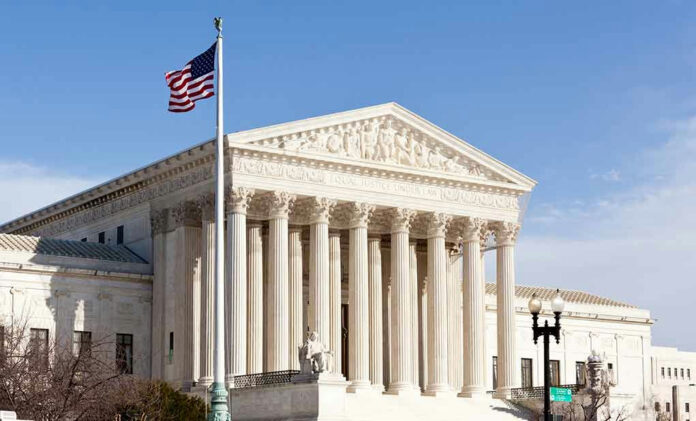
The Supreme Court has just handed President Trump sweeping control over most federal regulators, while carving out a special shield to keep the Federal Reserve largely beyond his reach.
Story Snapshot
- The Court overturned a 90-year precedent, giving the President broad power to fire independent agency heads at will.[3]
- At the same time, the Court preserved “for cause” protections for Federal Reserve governors, treating the Fed as a special case.[2][5]
- Critics warn this split lets unelected central bankers stay insulated while worker and consumer watchdogs become more exposed to politics.[1][4]
- The ruling raises big questions about accountability, constitutional limits, and who really runs economic policy in America.[4][5]
Supreme Court Reshapes Removal Power And Overturns Humphrey’s Executor
The Supreme Court’s decision in Trump v. Slaughter marks a major shift in how our government works. The majority ruled that the law protecting Federal Trade Commission commissioners from being fired except “for cause” violates the separation of powers and must fall. That holding follows the Court’s recent pattern of striking down limits on the President’s power to remove executive officials. In doing so, the justices explicitly overruled the 1935 case Humphrey’s Executor, calling it a “decaying husk” that could no longer guide modern constitutional law.[3][18]
Humphrey’s Executor had long allowed Congress to give certain independent agencies, like the Federal Trade Commission, strong protection from White House pressure. It said Congress could limit removal of commissioners who performed “quasi-legislative” or “quasi-judicial” functions, and for nearly ninety years that rule was treated as the foundation of independent agency law. Now, the Court’s conservative majority has rejected that approach. They say the President, as head of the executive branch, must be free to remove officials who exercise executive power, with only very narrow exceptions.[3][11][12][20]
Unitary Executive Victory Stops At The Federal Reserve’s Door
Supporters of President Trump’s position argued that the Constitution gives the President “exclusive and illimitable” removal power over executive officers. Recent decisions like Seila Law and Collins v. Yellen had already struck down protections for single-headed agencies, reinforcing this unitary executive view. In Trump v. Slaughter, the Court built on that trend by wiping out for-cause removal limits for multimember commissions such as the Federal Trade Commission, the Securities and Exchange Commission, and the National Labor Relations Board, at least as far as they exercise executive authority.[1][4][20]
Yet when it comes to the Federal Reserve, the Court drew a line. In prior emergency rulings and now more clearly, the justices treated the Fed as a “uniquely structured, quasi-private entity” rooted in the special history of the First and Second Banks of the United States. They said the for-cause protections for Federal Reserve governors cannot simply be converted into at-will employment, even while similar protections at other agencies fall. Justice Elena Kagan, in dissent, criticized this as a “bespoke Federal Reserve exception,” arguing the majority offered little real constitutional reasoning for shielding the central bank while exposing other regulators.[2][4][5][7]
What Fed Independence Means For Trump’s Power And Our Economy
For everyday Americans, this split has real stakes. Over the past year, the Court has allowed President Trump to remove leaders at agencies like the National Labor Relations Board and Merit Systems Protection Board, signaling that most independent commissions may now operate under much tighter presidential control. These agencies influence workplace rules, civil service protections, and consumer safeguards. Their loss of independence could mean policy swings whenever the White House changes hands, which worries left-leaning experts who prefer power in insulated boards instead of elected officials.[2][4][8]
…that Donald Trump can fire Rebecca Slaughter or any agency member for any reason (except for the Federal Reserve, which was ruled separately in Trump v. Cook).https://t.co/OecdDQ6Fa4
— Justin Gibson (@JGibsonDem) June 30, 2026
The Federal Reserve, however, keeps a special shield. The Court and even the government’s own lawyer acknowledged a long tradition of keeping monetary policy—interest rates and money supply—independent of direct presidential command. For-cause removal is seen as a key guardrail here, meant to prevent presidents from punishing Fed governors for pursuing tough inflation or interest rate decisions that might hurt short-term politics. Academic voices note that Congress has historically claimed primary authority over money creation, which they say supports keeping the Fed at arm’s length from the executive branch.[2][5][6][9]
Conservative Concerns: Unelected Power And A Murky Exception
From a constitutional conservative view, the Court’s ruling is a mixed bag. On one hand, restoring presidential removal power over most regulators brings these agencies back under a single, elected head instead of scattered boards that can push globalist, climate, or “woke” rules with little accountability. That lines up with the originalist scholarship saying Article II’s grant of “executive power” includes a core authority to remove executive officers, and that Congress cannot simply rewrite that power away through statute.[18][20][24]
On the other hand, the special treatment for the Federal Reserve leaves a powerful institution still largely beyond the reach of voters. The Fed’s choices help decide interest rates, housing costs, and the value of every paycheck, yet its governors remain insulated behind for-cause protections the Court would not allow for many other agencies. Critics argue this carve-out is “murky” and constitutionally thin, warning that the majority now picks and chooses which unelected bodies deserve independence instead of applying a clear rule tied to the Constitution’s text. For citizens worried about inflation, debt, and the long arm of central banking, that kind of exception only deepens doubts about who truly runs economic policy in America.[1][2][4][5]
Sources:
[1] Web – Can the Supreme Court Slaughter Slaughter Without Cooking Cook?
[2] YouTube – Oral Argument on Trump firing FTC Commissioners
[3] Web – Trump v. Slaughter – Constitutional Accountability Center
[4] Web – Trump v. Slaughter – Wikipedia
[5] Web – Trump v. Slaughter – Street Law Resource Library
[6] Web – [PDF] oral argument – SUPREME COURT OF THE UNITED STATES
[7] Web – Docket for 25-332 – Search – Supreme Court of the United States
[8] Web – Trump v. Slaughter – Ballotpedia
[9] Web – SLAUGHTER et al v. TRUMP et al, No. 1:2025cv00909 – Justia Law
[11] Web – Humphrey’s Executor v. United States | Oyez
[12] Web – Humphrey’s Executor v. United States – Wikipedia
[18] Web – What Does Humphrey’s Executor Mean?, by Nathaniel Wald Donahue
[20] Web – Executive appointment and removal power: a timeline – Ballotpedia
[24] Web – How to Think About the Removal Power – Virginia Law Review