

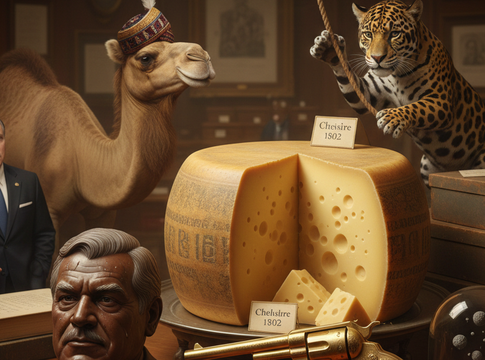
The exchange of gifts is a time-honored tradition in diplomacy, a symbolic handshake between nations. However, the U.S. presidency, with its unique blend of official duty and celebrity status, often attracts gifts that range from the priceless to the downright bizarre. While these items reflect the diverse cultural, political, and personal connections of the presidents, the Foreign Gifts and Decorations Act of 1966 ensures that most valuable gifts legally belong to the American people and are transferred to the National Archives.
Here are six of the most unusual and memorable gifts received by U.S. presidents.
1. The Mammoth Cheese (Thomas Jefferson)
In 1802, President Thomas Jefferson received a massive, 1,235-pound cheese wheel from the citizens of Cheshire, Massachusetts. The Baptists of Cheshire, led by Elder John Leland, intended the gift as a statement of support for Jefferson’s commitment to the separation of church and state.
This gift was remarkable for its size and for its explicit political symbolism. Jefferson, who paid $200 in delivery costs, accepted the cheese as a citizen and housed it in the White House, where it was served at a public New Year’s Day reception. It remains an iconic early example of an unconventional political tribute.
2. A Solid Gold, Engraved Revolver (Richard Nixon)
During his 1972 visit to Iran, President Richard Nixon received a lavish, custom-made firearm from the Shah of Iran, Mohammad Reza Pahlavi. The gift was a revolver featuring intricate engraving and made of solid gold. While technically impressive, such a personal and expensive gift highlighted the challenge of balancing diplomatic courtesy with ethical governance.
In compliance with the law, Nixon was not permitted to keep the valuable firearm. It was subsequently processed by the White House Gift Unit and eventually transferred to the National Archives, where it is preserved as a record of high-stakes diplomatic exchange during the Cold War era.
3. A Personal Turban and Camel (Theodore Roosevelt)
In 1904, President Theodore Roosevelt received a particularly exotic pair of gifts from Sheikh Mohammed Al Sunit, the ruler of Morocco. The gifts included a personal, ceremonial tribal turban and a camel. The turban was symbolic of honor and diplomatic respect, but the camel presented an immediate logistical challenge for the White House staff.
The camel was briefly housed at the White House before being transferred to the National Zoo. These unique gifts illustrate the wide gulf between American and foreign diplomatic customs, often resulting in amusing challenges for presidential staff.
4. A 100-Pound Chocolate Bust of the President (Lyndon B. Johnson)
President Lyndon B. Johnson, who was known for his colorful personality, received a gift that perfectly captured the spirit of mid-century American extravagance: a life-sized, 100-pound bust of himself sculpted entirely out of chocolate.
This edible tribute, which required careful climate control to preserve temporarily, was a highly unusual personal gift from an American organization. While less diplomatically significant than a foreign gift, it highlights the deeply personal and often whimsical nature of gifts offered by citizens eager to express their admiration or support.
5. A Pet Jaguar (John F. Kennedy)
Before he became president, while serving as a senator, John F. Kennedy was given a pet jaguar from a Brazilian politician. The exotic cat was a gift intended to demonstrate cross-cultural friendship and respect.
Like President Roosevelt’s camel, the jaguar could not be kept in a residential setting. It was quickly donated to a zoo where it could be cared for properly. This incident is a vivid reminder of the challenges presidents face in accepting gifts that, while generous in spirit, are wildly impractical for the recipient.
6. A Box of Stones from the Moon (Richard Nixon)
In 1969, following the historic Apollo 11 mission, President Richard Nixon was given an incredibly rare and historically significant gift: tiny samples of lunar rocks and dust collected by the astronauts. These gifts were typically mounted and presented in plaques to foreign leaders and governors as tokens of American technological triumph.
While these stones were of incalculable value, they were considered national property, representing the achievement of the U.S. government. They became part of the official collection of the National Archives, marking a unique moment where the gifts represented not a personal exchange, but a shared moment of human history.
The Legal and Ethical Framework
The acceptance and handling of these gifts are strictly regulated to maintain ethical standards and prevent corruption. The Foreign Gifts and Decorations Act stipulates that any gift from a foreign source exceeding a minimal value (currently adjusted for inflation) is legally the property of the United States government. Presidents may use or display the gifts while in office, but they must either purchase them at fair market value upon leaving office or surrender them to the National Archives or the relevant presidential library.
This rigorous legal process ensures that these unusual, extravagant, and often symbolic artifacts are preserved for historical record, providing both historians and the public a unique window into the personal and diplomatic history of the American presidency.