

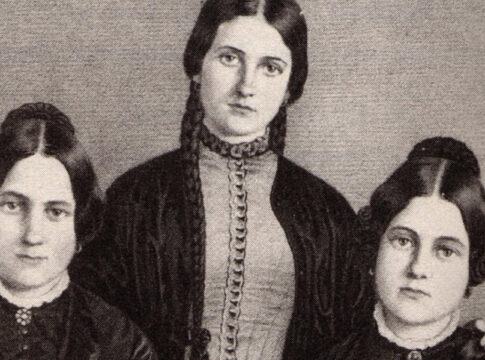
Two snapping toes in a drafty New York farmhouse didn’t just fool a family in 1848—they helped launch a profitable afterlife industry that refused to die even after the girls admitted the trick.
Hydesville, 1848: How a Household Prank Found the Perfect Audience
March 31, 1848 sits at the center of this story because the “rappings” weren’t a one-off scare; they became an interactive system. Kate (about 12) and Maggie (about 15) lived with parents who took strange sounds seriously, and the girls leaned into it. A simple back-and-forth routine—challenge the unseen “spirit,” get a response—turned childish mischief into a narrative the neighbors could repeat.
The clever part wasn’t the noise; it was the code. Once the family and neighbors accepted that knocks could carry meaning, every question became a new hook: Who are you? Why are you here? What do you want? Reports circulated that the entity was a murdered peddler with a name attached, which gave the haunting a plot instead of mere weirdness. When early investigations failed to settle things decisively, uncertainty did what it often does: it sold.
Rochester’s Quaker Network: The Early “Distribution Channel”
Late spring 1848 brought the second ingredient: adults with social reach. Amy and Isaac Post, Quakers in Rochester, took the girls in and helped publicize the phenomenon through meetings and personal networks. That matters because a rural haunting can burn out quickly, but Rochester offered rooms full of curious listeners and a respectable wrapper for an unusual claim. Word-of-mouth worked like a nineteenth-century algorithm, pushing the story outward.
The setting also lined up with the era’s psychological needs. America was steeped in revivalist energy and restless experimentation with religion, while confidence in institutions didn’t always keep pace with daily hardship. People wanted direct experience, not distant doctrine. The Fox sisters’ “spirit” provided something that felt hands-on: ask a question, receive a knock. In a culture that prized testimony, this looked like evidence—especially to grieving families hungry for reassurance.
Leah Fox and the Money Question: When Family Becomes Management
Older sister Leah didn’t invent the knocks, but she shaped the business. Once the attention grew, management became the difference between a parlor novelty and an income stream. Public séances and paid demonstrations turned “rappings” into a product, and Leah’s control over the act created a power imbalance inside the family. Conservative common sense recognizes the pattern: when money arrives fast, somebody steers—and somebody else pays the price later.
The turning point came on November 14, 1849, when the sisters appeared in a public paid demonstration at Corinthian Hall in Rochester. That date functions like a debut night for an entire genre. After that, touring and bigger-city attention followed, including New York City engagements. Media and celebrity interest amplified the act; endorsements and curiosity mixed together, and skepticism often arrived too late to matter because the audience had already bought the emotional experience.
Why the “Raps” Worked: Cheap, Repeatable, and Built for Belief
The Fox sisters’ method was unusually replicable compared to private visions or one-person revelations. A rap could happen again and again in front of witnesses, and the yes/no rhythm let sitters feel like participants rather than spectators. That interactivity is the secret sauce of many profitable fads, from chain letters to modern digital scams: the target thinks they’re driving the outcome. Add dim rooms, expectation, and social pressure, and the bar for proof drops fast.
Hard questions still hovered. Skeptics argued that the sounds clustered near the mediums’ feet, and later investigations and commissions treated “spirit phenomena” as a magnet for fraud. Those critiques align with a conservative instinct: extraordinary claims demand hard verification, especially when cash changes hands. Yet movements don’t run on logic alone. They run on community, ritual, and the promise that life’s worst losses might be reversible—or at least interpretable.
The 1888 Confession: A Public Unmasking That Didn’t End the Demand
In 1888, Maggie Fox publicly confessed at the New York Academy of Music and demonstrated how she made the sounds, widely described as toe-cracking. The confession damaged the sisters’ reputations and careers, and it gave skeptics the kind of vivid proof they crave: not a theory, but a live demonstration. The grim twist is that even a clear admission rarely wipes out a belief system once it has institutions, devotees, and a culture built around it.
Some believers leaned on partial recantations and the idea that early fraud doesn’t disprove later “real” gifts. That argument tends to spread when people have already invested money, identity, or grief into the story. The more practical takeaway is simpler and more American: consumers should treat spiritual services like any other market. If someone sells certainty about the unknowable, demand transparency, testing, and accountability—or accept you’re paying for theater.
Sources:
The Fox Sisters: Rise & Fall of Spiritualism’s Founders
The Fox Sisters and the Rise of Spiritualism
Margaret Fox and Catherine Fox
The Fox Sisters and the Great American Hoax: A New York Minute in History