
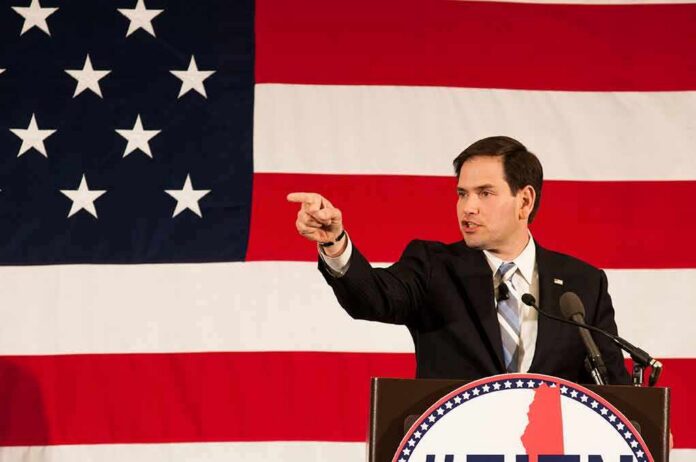
Secretary of State Marco Rubio says Iran has “lost complete control” of the Strait of Hormuz as oil flows rebound to near pre-war levels and ships keep moving under U.S.-led pressure to protect navigation.
Story Highlights
- Rubio says the strait is open and oil flows are near pre-conflict levels.
- Regional crude exports rebounded to pre-war volumes, easing energy fears.
- More Gulf oil now bypasses Hormuz through pipelines, reducing Iran’s leverage.
- U.S. pushed a United Nations measure to defend free passage and halt Iranian attacks.
Rubio: Strait Open And Iran’s Leverage Shrinking
Secretary of State Marco Rubio told reporters that the Strait of Hormuz is open and that oil moving out of the region is close to pre-conflict levels. Rubio said this shows Iran has “lost complete control” of the chokepoint. He added that Iran has no legal right to toll or block traffic in this international waterway. His message aimed to reassure markets and allies that energy supplies will keep moving and to deter more attacks on commercial ships.
Rubio’s claim lines up with fresh shipping data. Major outlets, citing tanker tracking, report Middle East crude exports returned to pre-war levels in late summer and early fall. That trend held even as incidents spiked. The rebound suggests Iran’s threats failed to choke supply the way Tehran hoped. That matters for every American who drives to work, pays for groceries, and depends on stable energy to hold down costs at home and on the farm.
Data Show Oil Is Moving Despite Threats
Reuters reported that regional crude exports exceeded pre-war levels for part of October, with flows recovering even as ships faced risk. European coverage echoed that recovery, noting that volumes bounced back while Iran tried to posture as gatekeeper. The data is not perfect and often excludes Iranian barrels, but it points to a simple fact: buyers are getting supply, tankers are sailing, and Iran is not dictating the terms of global energy trade.
Another shift weakens Tehran’s hand. More oil now bypasses Hormuz using pipelines across Saudi Arabia and the United Arab Emirates, which reduces exposure to the narrow lanes near Iran’s coast. Reports say those routes carried a larger share of exports compared with before the war, easing pressure on the strait itself. When energy can take multiple paths, it is harder for any one regime to hold the world hostage with a single chokepoint.
U.S. Pushes Lawful Navigation And Market Stability
The State Department said the United States proposed a United Nations Security Council measure to defend freedom of navigation and secure the strait. The draft calls on Iran to stop attacks, mining, and any tolling schemes. That effort backs a core American principle: open seas for lawful commerce. It also supports President Trump’s focus on stronger deterrence, clear rules, and steady energy supply that shields families from price spikes.
Defense leaders also highlighted quiet protection efforts that kept ships moving. Testimony reported this summer described U.S.-led guidance that helped move large oil volumes through the waterway despite risks. Together with the United Nations push, this shows a whole-of-government approach: diplomacy to rally allies, military presence to deter attackers, and energy coordination to blunt economic shock at the pump.
Tehran’s Claims Clash With On-The-Water Reality
Iranian officials keep saying they control Hormuz and can deny passage without their permission. State-linked messages claim only Iran-approved routes are safe and even talk of tolls. These statements are loud, but the shipping picture tells another story. Tankers continue to sail, alternative routes are growing, and the United States is rallying partners to defend transit rights. Iran can menace, but threats are not the same as control when the oil keeps moving.
Honesty demands one caveat. The available record does not include a formal court ruling that strips Iran of control, and some export data exclude Iranian barrels. That means we should avoid legal overreach. But the practical result is clear for American consumers and workers: markets calmed as flows returned, and Tehran has not shut down the sea lanes. Continued pressure, stronger escorts, and pipeline flexibility will further reduce Iran’s leverage and protect our wallets.
What It Means For Conservatives At Home
Stable energy is a kitchen-table issue. When tankers move, gas prices stay lower, trucking stays cheaper, and groceries cost less. Rubio’s stance defends the rule of law on the seas and rejects a pay-to-pass scheme from a hostile regime. That aligns with conservative values of strength, free trade under clear rules, and zero tolerance for extortion. The Trump administration’s mix of deterrence, diplomacy, and energy resilience is doing what matters most: keeping fuel flowing for American families.
Sources:
today.lorientlejour.com, english.ahram.org.eg, state.gov, reuters.com, euronews.com, nytimes.com