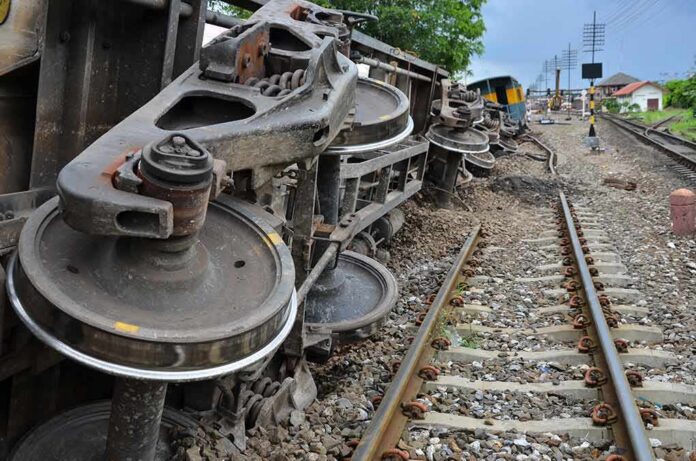
A government rail controller gave a fatal “go” order to a high-speed train stopped at a red signal, and Spain’s own transport minister says there is no explanation for why.
Story Snapshot
- Spain’s transport minister says a control center authorized a Renfe train to move past a red signal before it slammed into a stopped Iryo train near Toledo.
- The crash happened minutes after an automated safety system called LZB failed across a 39-mile stretch of track.
- The Civil Guard is questioning the Adif controller who cleared the train to proceed.
- Investigators have not yet determined the crash speed or why the controller’s order was given.
Minister Blames Control Center, Not Train Crews
Transport Minister Óscar Puente stood at Adif’s Atocha control center on October 28, 2026, and told reporters the decision to let the Renfe train resume its run was “inexplicable.” He placed responsibility squarely on the control center, not on the train drivers themselves. Puente’s choice of words put a government-run rail authority, not frontline workers, at the center of a disaster that killed dozens of passengers near Urda in Toledo province.
The admission matters because Spain’s rail network, like much of Europe’s, runs through state-controlled infrastructure. When a taxpayer-funded safety system fails and a government employee waves a train through a red light anyway, the public is left asking whether bureaucratic layers add safety or just add confusion.
Automated Safety System Failed Minutes Before Collision
A computer-related failure knocked out the LZB automatic train protection system across roughly 63 kilometers of track, which should have forced trains to stop on its own. Reports placed that failure at around 8:30 a.m., with the control center then authorizing the Renfe train to move again at about 8:36 a.m., despite the red signal still showing and no speed limit imposed. Six minutes separated a safety system going dark and a human giving the green light anyway.
The Iryo train was sitting still ahead on the same line when the Renfe train came up from behind and struck it. That configuration points to a basic breakdown: a following train was cleared to move while the system meant to stop it automatically was offline, and no backup check caught the mistake in time.
Investigators Question the Controller Who Gave the Order
The Civil Guard questioned the Adif controller at the Atocha traffic-control center, working to pin down exactly who gave each instruction, when it was given, and the precise wording used. That detail shows this is not just a political accusation from a cabinet minister. It is now a formal investigative lead, with Spanish authorities treating the controller’s decision as the central fact to nail down.
Investigators have not yet established the Renfe train’s speed at impact or whether its driver had any chance to brake before hitting the stopped Iryo train. The exact reason the Iryo train had not resumed moving also remains unclear. Those gaps do not change what the minister already said happened. They simply mean the full technical picture is still being assembled by Spanish rail and judicial authorities.
A Pattern Bigger Than One Bad Order
Rail-safety researchers who study crashes like this one consistently find that a single human decision is rarely the whole story. One review of nearly a hundred railway accidents found contributing factors split almost evenly between frontline mistakes and deeper organizational failures, including training, supervision, and equipment reliability. A government-run system that lets a critical automated safeguard fail and then lets one controller’s unexplained call fill the gap is a system with more than one broken link.
#Now #Urgent
Two high-speed trains #AVE collide near #Toledo, #Spain, derailing carriages & causing multiple casualties. #Madrid–#Andalusia rail services suspended. Emergency helicopters deployed. Cause under investigation. https://t.co/w8JUw0ElCQ— Mexico Times (@mexicotimes) October 28, 2026
For American conservatives who have long distrusted top-heavy, government-managed infrastructure, Spain’s crash is a sobering case study. A state-run rail network, layered with automated systems and central control rooms, still came down to one unexplained human order after the machines failed. Centralized bureaucracy did not prevent catastrophe. It may have set the stage for it.
Sources:
insiderpaper.com, dw.com, timesnownews.com, nampa.org