

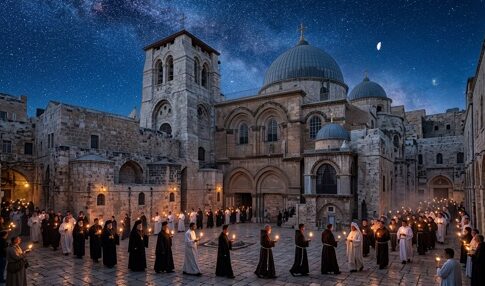
For the first time in centuries, Israeli police barred Catholic leaders from celebrating Palm Sunday Mass at Christianity’s holiest site, igniting a fierce debate over religious freedom during wartime that even Prime Minister Netanyahu couldn’t ignore.
When Security Trumps Sacred Tradition
Cardinal Pizzaballa and Father Patton received the stunning news on Saturday, March 28: Israeli police would not permit their planned private Palm Sunday Mass at the Church of the Holy Sepulchre. The explanation centered on safety protocols established during the Iran war, which began February 28 and brought missile strikes near Jerusalem’s Old City. Authorities cited inadequate bomb shelters, restricted emergency vehicle access through narrow alleys, and regulations limiting gatherings to 50 people without proper protection. The two church leaders, representing the Latin Patriarchate and Custody of the Holy Land, found themselves stopped en route to Christianity’s most sacred shrine the following morning.
The irony stung sharply. The church had hosted non-public Masses since the war’s outbreak without incident. Israeli authorities applied restrictions uniformly across faiths, limiting access to the Western Wall and Muslim sites under identical Home Front Command rules. Yet church spokesman Farid Jubran questioned why a private Mass, far smaller than previous gatherings, warranted complete prohibition on such a significant day. The answer from Israeli officials remained consistent: wartime conditions demanded absolute adherence to safety protocols, regardless of religious significance or historical precedent.
A Precedent That Threatens Centuries of Agreement
The Church of the Holy Sepulchre sits at the intersection of faith and diplomacy. Built over the sites where Christians believe Jesus was crucified and resurrected, the church operates under the Status Quo agreement established in 1852. This delicate arrangement governs access and worship rights among Catholic, Orthodox, and Armenian communities, preserving a balance that has survived wars, occupations, and political upheaval. Palm Sunday traditionally draws global pilgrims for processions from the Mount of Olives, a spectacle already canceled due to the conflict. The denial of even a private Mass pushed church leaders past their breaking point.
The joint press release from the Latin Patriarchate and Custody of the Holy Land pulled no punches. They called the decision “manifestly unreasonable and grossly disproportionate,” arguing it defied both rationality and the Status Quo framework. Their statement emphasized compliance with previous wartime restrictions while highlighting the unprecedented nature of barring clergy from their own sanctuary. The phrase “dangerous precedent” carried weight beyond rhetorical flourish. If Israeli authorities could prevent worship at the Holy Sepulchre during war, what protections remained for religious freedom when security concerns arose in the future?
Netanyahu’s Damage Control
The backlash reached the Prime Minister’s office with remarkable speed. By Sunday evening, Netanyahu took to social media platform X, declaring no malicious intent behind the restriction and announcing plans for partial church access during Holy Week. Israeli police echoed this conciliatory tone, emphasizing active dialogue with Cardinal Pizzaballa to develop solutions balancing worship rights with safety requirements. The swift response suggested Netanyahu recognized the political and diplomatic stakes. Alienating billions of Christians worldwide over a single Mass risked far more than the immediate security calculation warranted.
The church’s position carried logical force. They had demonstrated willingness to adapt worship practices during the five-week conflict, accepting limitations while maintaining spiritual obligations. The sudden shift from accommodation to complete denial, particularly on Palm Sunday, appeared arbitrary rather than principled. Israeli officials maintained their actions reflected uniform enforcement across all faiths, not targeted discrimination against Christians. Yet the optics remained troubling: armed police preventing elderly clergy from praying at a site Christians have accessed for nearly two millennia.
The Price of Wartime Restrictions
Jerusalem’s Old City presents genuine security challenges during wartime. Iranian missiles had struck near the ancient walls, and the labyrinthine streets genuinely complicate emergency response. Home Front Command’s restrictions on large gatherings without adequate shelters serve legitimate safety purposes. The question becomes proportionality. Does preventing two clergy members from conducting a private Mass serve public safety, or does it represent security theater that sacrifices fundamental rights for minimal risk reduction? The church clearly believes the latter, while Israeli authorities maintain the former.
The broader implications extend beyond one interrupted service. Religious tourism sustains significant portions of Jerusalem’s economy, already battered by ongoing conflict. More fundamentally, the incident exposes tensions inherent in managing multi-faith holy sites during wartime. Israel controls access to locations sacred to billions worldwide, creating responsibility that transcends normal sovereign authority. The Status Quo agreement exists precisely because these sites demand special consideration beyond typical security calculations. When missiles fly, that delicate balance faces its greatest test.
Sources:
Israel prevents Catholic leaders from celebrating Palm Sunday Mass at Jerusalem church – Politico
Israel bars Palm Sunday Mass at Jerusalem church – The Independent
Israel Prevent Palm Sunday Mass – IMEMC