

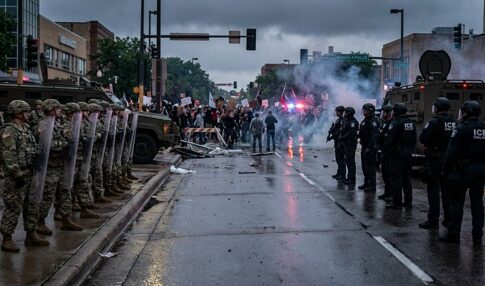
A fresh video of a protester baiting an ICE officer in Minneapolis is now at the center of a deadly shooting debate that perfectly exposes America’s battle over law, order, and weaponized activism.
New Taunting Video Intensifies Debate Around Deadly ICE Encounter
Newly circulated footage showing a protester taunting an ICE officer on a snowy Minneapolis street has become the latest flashpoint in a deadly shooting that already divides the country. The brief clip, widely shared by activists and commentators, captures a heated confrontation near the scene where 37‑year‑old Renee Good was shot and killed during an immigration operation. While the video does not show the shooting itself, it underscores how federal officers now carry out dangerous work in an increasingly hostile, activist-charged environment.
Federal officials say ICE officer Jonathan Ross fired three shots in roughly three seconds after perceiving Good’s vehicle as a lethal threat during the operation. They argue that agents on that residential street faced real danger as tensions escalated and vehicles moved in close quarters. Protesters and local critics counter that the videos released so far do not clearly prove Good tried to run down the officer, insisting the shooting represents another unjustified killing in a city scarred by past police abuses.
Five Left-wing narratives instantly crumble with the body cam footage:
1) Renee was terrified for her life.
She absolutely was NOT. She was smiling and taunting officers. Literally zero fear.2) The officer was not hit.
Clearly, he was hit HARD.3) Renee didn't know who the… pic.twitter.com/ufn5TJR7Oh
— Matt Van Swol (@mattvanswol) January 9, 2026
Competing Narratives: Self‑Defense Versus Federal Overreach
From Washington, the Trump administration has framed the case as a textbook example of law enforcement under siege. President Trump has described Good as weaponizing her car against a veteran ICE officer, fitting the incident into a broader law‑and‑order message that emphasizes protecting agents tasked with enforcing immigration law in defiant blue cities. Vice President JD Vance has echoed that line, telling Americans that Good’s actions were an attack on law and order and blasting media outlets he says rush to vilify officers while excusing radical protest tactics.
Minneapolis officials, led by Democratic Mayor Jacob Frey, have fired back and tried to seize control of the narrative and the investigation. After reviewing video, Frey publicly dismissed self‑defense arguments as “garbage” and demanded that Minnesota’s Bureau of Criminal Apprehension be formally involved. Activists and civil‑rights groups have rallied behind that position, arguing federal agencies like ICE and DHS cannot credibly police their own. For many residents, the memory of previous high‑profile police killings in the city intensifies suspicion of any official account that quickly clears an officer.
Breaking New Video shows Renee Nicole Good taunting ICE and wife pic.twitter.com/yLMHl2ePCk
— The Real Doctor Of Common Sense (@RealDoctorET) January 9, 2026
Protests, Police Tactics, and the Weaponization of Video Evidence
In the days after Good’s death, protests swelled in Minneapolis and spread to other cities, with demonstrators condemning ICE, chanting against Trump, and calling for Ross to be prosecuted. Crowds shut down streets near the shooting site, forcing the city to juggle access for emergency vehicles while preserving a growing memorial. As more cell‑phone angles, surveillance clips, and commentary segments emerged online, each side seized on whichever frames best supported its storyline, turning “three seconds and three shots” into a national Rorschach test for policing in the Trump era.
The taunting video now driving headlines does not answer the crucial legal question of whether Ross reasonably believed he faced deadly force from Good’s car. It does, however, illustrate the aggressive posture many protesters now take toward federal officers, baiting and berating them at close range. For readers who believe in law, order, and secure borders, that matters: officers are being asked to enforce already contentious policies while standing in the crosshairs of activists, cameras, and politicians eager to score points off every split‑second decision.
Sources:
ABC News live updates: Minneapolis ICE shooting tensions and investigation