

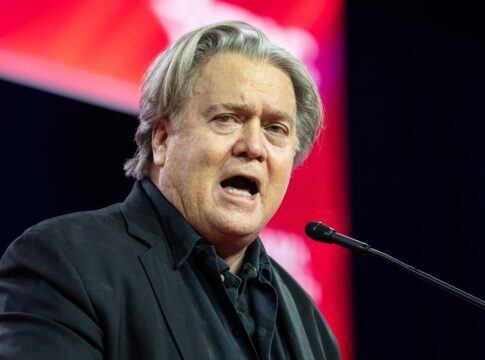
Steve Bannon’s call for ICE agents and military troops to surround polling stations in November raises serious questions about federal overreach and the constitutionality of militarizing American elections.
Bannon’s Controversial Proposal for Federal Election Control
Steve Bannon announced on his podcast in early February 2026 that ICE agents should surround polling stations during the November midterms, stating “We’re going to have ICE surround the polls come November. We’re not going to sit here and allow you to steal the country again.” The following day, Bannon escalated his rhetoric by urging President Trump to invoke the 1807 Insurrection Act and deploy elite military units like the 82nd and 101st Airborne Divisions to enforce voter ID checks and citizenship verification at polls. Bannon framed recent ICE deployments at airports during a partial government shutdown as training exercises for this proposed election-day operation.
Legal and Constitutional Barriers to Military Poll Deployment
Federal law explicitly prohibits military or armed federal presence at polling locations, with several states classifying such actions as criminal offenses. The Insurrection Act, while granting presidents authority to deploy military forces domestically during insurrections or civil disturbances, has been invoked rarely throughout American history and faces significant legal restrictions when applied near elections. Trump previously threatened to invoke the act during immigration-related unrest in Minneapolis in January 2026 but later retracted the threat. White House Chief of Staff Susie Wiles had previously dismissed similar troop deployment proposals in 2025 as “categorically false,” creating uncertainty about whether Trump would actually pursue Bannon’s recommendations.
Escalating Federal Pressure on State Election Systems
Bannon’s comments emerge amid broader Trump administration efforts to centralize election oversight at the federal level. Recent months have seen the Justice Department filing lawsuits against Democratic-led states demanding voter roll data, while the FBI seized 2020 ballots in Georgia as part of ongoing investigations. These actions represent a significant departure from traditional state control over election administration, a principle long defended by conservatives as essential to constitutional federalism. The administration’s push conflicts with the foundational conservative value of limited federal government and state sovereignty in managing local affairs, including elections.
Democrats and civil liberties advocates warn that deploying federal law enforcement or military personnel to polling locations would constitute voter intimidation, particularly targeting immigrant and minority communities already wary of ICE enforcement actions. The proposal raises fundamental questions about whether election security measures cross the line into suppression tactics. Multiple states have laws specifically criminalizing armed presence at polls, designed to protect the right to vote free from coercion. Any deployment would likely trigger immediate legal challenges questioning both statutory authority and constitutional protections for free and fair elections.
Concerns About Normalizing Federal Election Intervention
The long-term implications of Bannon’s proposal extend beyond the 2026 midterms. Normalizing federal military or law enforcement presence at polling stations would fundamentally alter the relationship between citizens and their government during the most sacred civic act—voting. This represents a troubling expansion of federal power that should alarm conservatives who campaigned against government overreach. The proposal echoes unproven 2020 election fraud claims while offering a remedy that potentially creates greater constitutional violations than any alleged problems it purports to solve. For MAGA supporters already frustrated with Trump’s broken promises on avoiding new wars and maintaining American sovereignty, this represents another example of big government solutions contradicting core conservative principles of individual liberty and limited federal authority.
"ICE officers at airports a ‘test run’ for deployment at midterm polling stations, Steve Bannon says – US politics live" –
The Guardian #SmartNews https://t.co/I7LLrVZlPT— Caroline Ramsey-Hamilton (@RiskAlert) March 24, 2026
As of early February 2026, no confirmed deployments have been announced by the Trump administration, leaving Bannon’s statements as provocative rhetoric rather than actionable policy. The tension between Bannon’s public calls and previous White House denials highlights divisions even within Trump’s inner circle about the wisdom and legality of such proposals. Voters concerned about election integrity must weigh whether federal militarization of polling places protects or threatens their constitutional rights, especially when existing laws already prohibit the very tactics being proposed.
Sources:
Steve Bannon calls for Trump to deploy ICE and military troops to polling sites – Politico
ICE at airports is training for ICE at polls – The Ashland Chronicle
This is not militarization or ‘takeover’.
It IS needed to check I.D.s and prevent foreigners from voting in American elections, and nullifying the dem steal.