
When combustible symbolism crosses into deliberate endangerment, the law is unambiguous: using accelerants and improvised pyrotechnics at the doors of a federal facility is not protest; it is a criminal attack that puts bystanders, responders, and public servants at risk.
The Short Version
- Authorities detained a 43-year-old Army veteran after he ignited fireworks and set a gasoline-fed fire outside 26 Federal Plaza in Manhattan, a building that houses ICE and other federal offices.
- Investigators and prosecutors describe the incident as a targeted arson using an incendiary device, not a demonstration that got out of hand.
- Early charging documents and briefings indicate additional weapons were present and that the suspect voiced an intent to harm; arson charges followed quickly.
- Legally and operationally, federal buildings are hardened for precisely these scenarios; the threshold between protected speech and violent criminality is bright and well established.
What Happened Outside 26 Federal Plaza
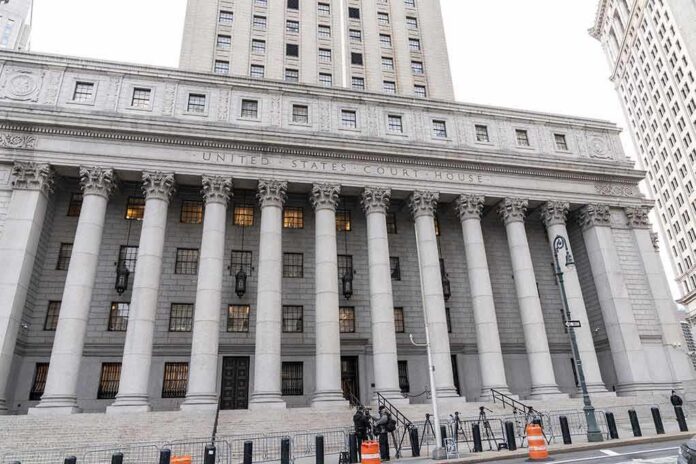
On a weekday morning in Lower Manhattan, a former U.S. Army soldier allegedly arrived at 26 Federal Plaza—the complex that includes an immigration court and Immigration and Customs Enforcement offices—poured gasoline on the steps near an employee entrance, and used fireworks as an ignition source. According to contemporaneous briefings and subsequent coverage, he also brought air-powered rifles or similar devices to the scene. Agents on site and New York responders moved quickly to suppress the flames and take the suspect into custody. Within a day, federal prosecutors filed arson charges, describing the fire as a deliberate attack with an incendiary device against a federal building.
In the early information window after any serious incident, precision matters. Here, the core facts have been consistent across outlets and official briefings: accelerant was used; fireworks were lit; the target was a federal complex that houses immigration functions; custody was immediate; the FBI’s Joint Terrorism Task Force assumed the lead investigative role, as is routine when federal facilities are attacked.
How Law Draws the Line: From Speech to Arson
American law gives expansive protection to expression in public spaces, including outside government buildings. That protection ends at violence and the credible threat of it. The federal arson statute (18 U.S.C. § 844) criminalizes maliciously damaging or attempting to damage, by means of fire or an explosive, any building or property used in interstate commerce or owned by the United States. Prosecutors commonly treat a fuel-and-firework combination as an “incendiary device” in charging language because, in function, it is designed to propagate flame and cause damage. That classification is about mechanism, not motive; whether the banner reads “Abolish ICE” or “Support ICE” is irrelevant to the element of the offense.
Why does the line sit there? Because accelerants and pyrotechnics are not symbolic. They radiate heat, generate toxic smoke, and can unpredictably escalate into structural fire. On a federal campus with employees arriving and leaving, the risk calculus is straightforward: ignition at an entrance can trap occupants, force evacuations, and endanger passersby and first responders. That is why, in cases like this one, agencies emphasize intent and capacity to harm in early statements and filings—and why a rapid arson charge followed in Manhattan.
Why Immigration Facilities Become Flashpoints
Immigration enforcement sites concentrate political anger by their very function. Dockets move families through removal proceedings; enforcement actions upstream of the courthouse can be controversial; and the buildings themselves become metonyms for broader policy fights. That is well documented at 26 Federal Plaza, long a locus for demonstrations of all kinds. In such spaces, the coexistence of protected protest and criminal conduct is not hypothetical; it is a recurring problem set for urban police and federal protective services. Early reporting on incidents at these facilities tends to lean on law-enforcement characterization—who arrested whom, what was seized—until affidavits and courtroom proceedings harden the record.
That sequencing can lead casual readers to conflate protest with violence. The remedy is not to blur the categories but to clarify them. Chanting on a plaza, even loudly and provocatively, is speech. Deploying gasoline, fireworks, or pellet guns at a doorway is violence, and it is policed accordingly—no matter which side of the immigration debate the actor claims.
Mechanics of the Response: How Security Protocols Work
Federal facilities operate under layered protection: physical barriers, surveillance, on-site Federal Protective Service (FPS) or task force coverage, and close integration with municipal fire and police. When an ignition event occurs—especially one involving visible pyrotechnics—the first imperatives are life safety and perimeter control: suppress the fire, prevent ingress and egress through compromised doors, and separate the attacker from crowds and employees. Simultaneously, investigators secure residues and devices for forensic analysis and interview witnesses for timeline reconstruction. The FBI’s New York Joint Terrorism Task Force typically assumes lead when indicators suggest ideologically motivated violence or when a federal complex is targeted, as it did here.
These protocols are designed for speed because time magnifies risk. A fuel fire can flash over, migrate to interior spaces, or trigger panic-driven crowd movement. The same discipline that governs bomb threats—a bias toward over-response in the first minutes—applies to improvised incendiaries outside federal buildings.
The Case Posture: Charges, Evidence, and What Survives Scrutiny
After custody and scene stabilization, prosecutors must translate a chaotic event into chargeable conduct anchored in evidence. In Manhattan, the government moved on arson charges within roughly 24 hours and, according to reporting on the initial hearing, alleged premeditation and intent to harm. That early charging posture suggests investigators had more than just video of a blaze; they likely had device components, accelerant residues, and statements—either spontaneous or Mirandized—linking the suspect to planning and motive.
Not every early investigative claim survives adversarial testing. But certain facts, once charged, tend to be durable: the presence of accelerant, the act of ignition, the federal character of the target, and the suspect’s possession of additional devices or replica firearms. Those elements, reflected across briefings and filings in this case, are precisely the ones necessary to sustain an arson count and related weapons charges.
Incident Summary at 26 Federal Plaza, NYC🚨:
• Early Morning Attack: Around 8:20 AM, a man with anti-ICE signage on his cart launched fireworks outside the building, striking and grazing a bystander.
• Arson Attempt: He then poured what authorities believe was gasoline on… pic.twitter.com/jsiw1TGqPH
— Officer Lew (@officer_Lew) July 20, 2026
Why the Label Matters—And Why Motive Does Not
In public debate, incidents like this are often narrated as “protest gone wrong.” Legally, that framing is beside the point. Arson is result-and-method driven; it turns on fire, device, target, and malicious intent. Motive can aggravate sentencing or inform terrorism enhancements, but it does not convert an incendiary attack into protected speech. The consistency of official language around this Manhattan event—incendiary device at a federal building, immediate detention, arson charge—tracks that settled doctrine.
Implications: Deterrence, Public Space, and a Harder Future
Three implications flow from this episode. First, deterrence: swift charges in clear-cut cases signal that weaponizing pyrotechnics around federal facilities will be treated as felonies, not expressive acts. Second, the architecture of protest: city governments and federal site managers will continue to cordon staff entrances and harden perimeters, preserving protest space while insulating mission-critical access points—and that makes spontaneous, porous public forums rarer. Third, prosecutorial focus: when investigators can show premeditation and acceptance of collateral harm, as reports here indicate, expect judges to remand defendants and impose restrictive conditions; the system prioritizes incapacitation where risk to the public is demonstrated.
Bottom Line
Americans can and do argue policy on the steps of their government buildings. The constitutional order insists on it. But line-drawing matters. Bringing gasoline and fireworks to a federal doorway is not a rhetorical flourish on a hard question; it is arson. The Manhattan case demonstrates the system working as designed: rapid interdiction, clear charging, and a forum—court, not plaza—where evidence will finish the story that the flames began.