

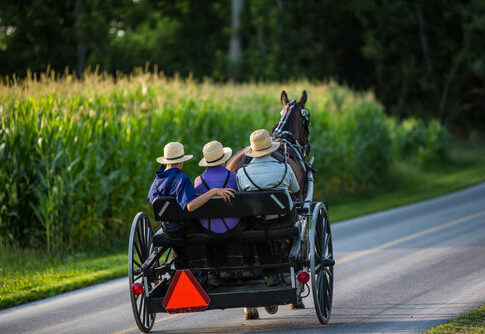
A catastrophic highway crash in Indiana that killed four people, including members of the Amish community, has exposed a deadly pattern connecting Biden-era immigration policies to commercial trucking licenses now prompting a federal crackdown across America’s highways.
When Immigration Policy Meets Highway Safety
The Tuesday morning crash unfolded when Beishekeev failed to brake for slowing traffic on an Indiana highway. He swerved into oncoming lanes, slamming his semi-truck directly into a van packed with 15 passengers. Four people died instantly. Jay County authorities arrested Beishekeev at the scene, and Immigration and Customs Enforcement immediately placed a detainer on him. The crash wasn’t an isolated tragedy. It represented the culmination of policy decisions made hundreds of miles away in Washington, D.C., where the Biden administration’s CBP One mobile app had paroled over one million foreign nationals into the United States, including Beishekeev on December 19, 2024.
The CBP One Gateway and State Licensing Failures
Pennsylvania’s Department of Transportation handed Beishekeev a commercial driver’s license seven months after his parole, in July 2025. This wasn’t bureaucratic oversight but systemic failure. States including Pennsylvania and Washington had been issuing CDLs to non-domiciled and undocumented drivers, sometimes through training programs inadequate to screen applicants’ immigration status. The Federal Motor Carrier Safety Administration noticed. By September 2025, the agency implemented emergency rulemaking specifically targeting approximately 200,000 non-citizen CDL holders. The regulation came too late for the victims of crashes that had already painted America’s highways with blood throughout 2025.
A Year of Fatal Crashes and Federal Inaction
August 2025 brought Harjinder Singh’s crash in Florida that killed three people. October delivered a brutal nine-day span where two separate big-rig crashes claimed four lives: Borko Stankovic’s fatal Indiana collision and Jashanpreet Singh’s chain-reaction disaster in California that killed three more. Rajinder Kumar added to the death toll in Oregon. Juan Hernandez-Santos caused a pile-up involving a school bus in Washington, mercifully without fatalities. Each driver held a CDL. Each had ICE detainers issued. The pattern became undeniable when federal authorities tallied at least 10 deaths from this specific category of crashes in 2025 alone, prompting Transportation Secretary Sean Duffy to launch nationwide audits of commercial licensing programs.
Sanctuary Policies Versus Public Safety
The Hernandez-Santos case in Washington state crystallized the conflict between local sanctuary policies and federal immigration enforcement. Thurston County authorities released him despite an active ICE detainer, a decision DHS Assistant Secretary Tricia McLaughlin condemned as creating a “walking public safety threat.” Her assessment wasn’t hyperbole. Many of these drivers carried criminal histories including DUI convictions and drug offenses alongside their questionable CDLs. White House Press Secretary Karoline Leavitt characterized the CBP One app as a “magic pass” that enabled foreign nationals to bypass normal vetting, obtain state identification documents, and access jobs requiring security clearances like commercial trucking. The administration vowed mass deportations, and by November 2025, DHS had arrested approximately 150 illegal immigrant truckers, including one whose crash killed a National Guard member.
Economic Pressures and Regulatory Response
The federal crackdown created immediate consequences beyond public safety. Revoking 200,000 CDLs overnight threatened to exacerbate an already severe driver shortage plaguing the trucking industry. Supply chain disruptions loomed. Freight costs faced upward pressure. Trucking companies confronted new compliance burdens as DOT audits demanded proof of proper documentation for every driver. The Amish families burying their dead cared nothing for these economic calculations, but the collision between immigration policy and highway commerce was reshaping both. States that had issued licenses improperly now faced federal funding threats and intensive scrutiny of their training programs, particularly Washington, where procedural gaps had allowed unqualified applicants to slip through.
The Broader Implications of Preventable Tragedy
Beishekeev remains in Jay County Jail with an ICE detainer, his case symbolic of policy failures that transformed highway travel into deadly roulette. The victims’ families gained nothing from political debates over borders and licensing, but their losses fueled a fundamental shift in enforcement. The current administration seized these tragedies as evidence justifying stricter immigration controls and deportation priorities. Whether tighter CDL regulations and immigration enforcement will prevent future crashes or merely shift economic burdens onto the trucking sector remains uncertain. What’s undeniable is that four people died in a van in Indiana because systems designed to protect public safety failed catastrophically at multiple levels of government, from border parole to state licensing to local detention policies that prioritized ideology over ICE detainers.
Sources:
Criminal illegal alien truck driver released from custody after crash – Overdrive
ICE detainer placed on Illinois truck driver after fatal Indiana crash – Fox 32 Chicago
Four dead as illegal immigrant semi-truck driver plows into Amish van in Indiana – KRCR
Four dead as illegal immigrant semi-truck driver plows into Amish van in Indiana – CNY Central
Semi-truck driver held by ICE – AOL