

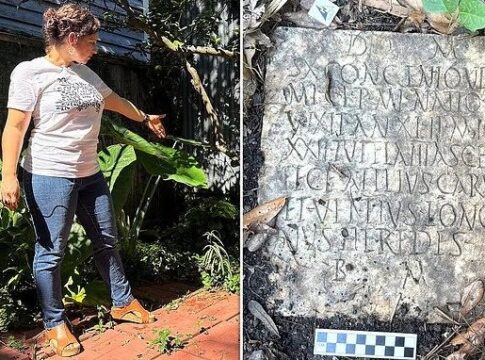
New Orleans, Louisiana – In the historic Carrollton neighborhood, a routine backyard cleanup in the spring of 2025 yielded a discovery that defied geography and time. What anthropologist Daniella Santoro and her husband, Aaron Lorenz, pulled from beneath the undergrowth was not yard debris, but a heavy marble slab bearing an inscription in Latin—an ancient Roman tombstone that had been missing since the height of World War II.
The artifact, now verified by classicists and archaeologists, is the gravestone of Sextus Congenius Verus, a Thracian-born soldier who served in the elite Classis Misenensis, the Praetorian fleet of the Roman Empire, during the 2nd century CE. His service was spent at the port of Centumcellae, modern-day Civitavecchia, Italy, where the stone was originally placed by his heirs.
The Transatlantic Journey of a War Trophy
For decades, the tombstone lay thousands of miles from its origin, silently serving as garden decoration in the American South. The key to the artifact’s incredible journey lay in a single, devastating moment: the 1944 Allied bombing of Civitavecchia, which destroyed the local museum where the stone was housed.
“This is not a local artifact, which immediately raises questions about how it got here,” explained Dr. D. Ryan Gray, an archaeologist who helped verify the find.
The investigation traced the stone’s path back through New Orleans property records to a family who had inherited it from Charles Paddock Jr., an American veteran who served in the European theater during WWII. It is strongly believed that Paddock, like many soldiers seeking souvenirs, took the stone from the bomb-shattered museum and brought it home, where it became an heirloom passed down through generations.
Erin Scott O’Brien, the previous owner who inherited the stone, shared that it had been a fixture in her grandparents’ garden for years. Unaware of its true significance or its connection to wartime displacement, the family treated the ancient gravestone as a curiosity.
Repatriation and the Ethics of Heritage
The discovery quickly involved the academic community, including Dr. Susann Lusnia, a Tulane classicist who confirmed the inscription’s authenticity. Once the stone was definitively traced back to the lost collection in Civitavecchia, Italian authorities were notified, initiating a formal repatriation process.
The artifact is now in the secure custody of the FBI Art Crime Team, preparing for its long-delayed return to Italy.
This high-profile case serves as a stark reminder of the widespread cultural damage inflicted during WWII, when thousands of artifacts were looted, misplaced, or taken as unauthorized souvenirs. While the circumstances of its removal remain speculative, the successful tracing and impending return of Verus’s tombstone underscores a crucial commitment to ethical stewardship and international cooperation.
For the Italian people, retrieving the gravestone of Sextus Congenius Verus means more than just recovering marble; it means restoring a piece of their documented history and closing an 80-year chapter of loss, bringing a Roman soldier’s memory home at last.