

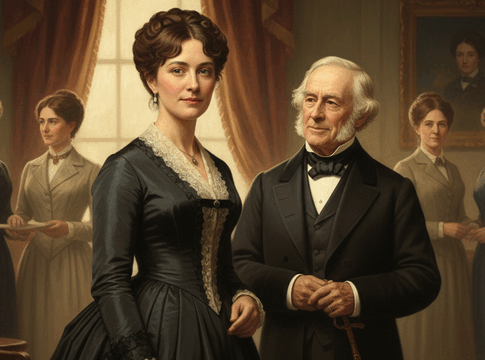
The role of the First Lady of the United States is one of immense public visibility and informal influence. While the position is strongly associated with the president’s spouse, history reveals a more flexible and, at times, unconventional tradition. Because the role is one of custom, not constitutional mandate, it has frequently been filled by other women—daughters, nieces, sisters, or daughters-in-law—when the president was unmarried, widowed, or when his wife was unable to serve.
These women, often referred to as “White House hostesses,” played critical social, ceremonial, and even political roles, effectively serving as the nation’s First Lady and shaping the public face of the presidency.
The Early Necessity
The precedent for non-spousal First Ladies was set early in the nation’s history. When Thomas Jefferson assumed office in 1801, his wife, Martha, had already passed away. His eldest daughter, Martha Jefferson Randolph, became the first woman to fill the role without being married to the president. She managed the White House household and executed necessary social duties.
The 19th century presented several other instances where a male relative was called upon to fill the void:
- Andrew Jackson’s wife died shortly before his inauguration (1829). The role was primarily shared by his niece, Emily Donelson, and later, his daughter-in-law, Sarah Yorke Jackson.
- The presidency of bachelor James Buchanan (1857–1861) provided one of the most prominent examples. Buchanan’s niece, Harriet Lane, served as First Lady, using her position to become a highly visible public figure and advocate.
Shaping the Role’s Power
These non-spousal hostesses were not merely ceremonial figures; their unique relationship with the president often granted them considerable informal influence.
Harriet Lane is often cited as the most significant non-spousal First Lady. She was regarded as the “Lady of the White House” and effectively utilized her position to become a social and political influencer. She championed the arts and supported improvements in the lives of Native Americans, demonstrating the potential of the role to extend beyond household management into policy advocacy.
Similarly, Mary Arthur McElroy, sister of President Chester Arthur, brought a sense of grace and dignity back to the White House following the death of Arthur’s wife. Their service proved that the social expectations of the presidency could be upheld by a trusted female family member.
Legacy and Conclusion
Since the early 20th century, the role has been exclusively held by the president’s wife. However, the history of non-spousal First Ladies underscores the adaptability of the office. Their service ensured essential continuity in White House social functions and public representation during periods of personal difficulty for the presidents.
Their contributions highlight that the power and profile of the First Lady are derived not from marriage, but from the proximity to presidential power and the willingness of the individual to embrace a high-profile, unelected public role. Their stories are a vital part of the evolution of the First Lady’s office, revealing a deep history of women wielding influence on the national stage.