

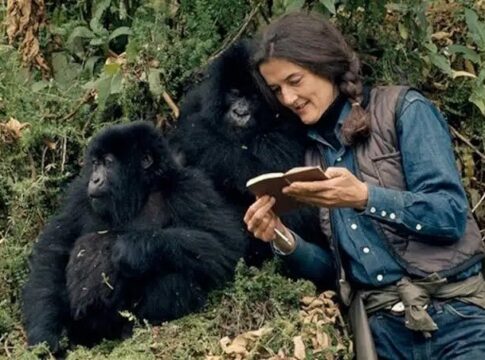
A scientist’s obsession with protecting gorillas cost her everything, and four decades later, her killer remains free.
From Researcher to Warrior
Dian Fossey arrived in Rwanda’s Virunga Mountains in 1966 as a quiet observer, following Louis Leakey’s vision of studying primates in their natural habitat. She shared this mission with Jane Goodall and Biruté Galdikas, part of what became known as the trimates initiative. For over a decade, Fossey documented gorilla vocalizations, family structures, and social hierarchies that transformed scientific understanding. Her 1983 book Gorillas in the Mist cemented her reputation as a world-class researcher.
Everything changed on New Year’s Eve 1977 when poachers killed Digit, Fossey’s favorite gorilla, decapitating him to sell his head as an ashtray. The mutilation shattered her commitment to passive observation. Fossey abandoned her notebooks for patrol boots, trading research for revenge. By 1978, she had shifted entirely toward confrontation, destroying poacher traps and burning camps. In early 1984 alone, she reported cutting 584 traps. She marked cattle with paint to humiliate herders encroaching on gorilla habitat and armed her research team for protection.
This transformation separated Fossey from her contemporaries. While Goodall maintained diplomatic relationships with local communities, Fossey declared war. She saw compromise as surrender and locals as obstacles to conservation. Her methods won international support and protected gorilla populations, but they created enemies who lived in poverty while watching a foreign woman enforce park boundaries against their survival strategies.
The Night Everything Ended
On December 27, 1985, research assistant Wayne McGuire discovered Fossey’s body in her cabin. Someone had entered through a hole cut in the wall and struck her down with a machete blow to the head. She was 53 years old. The Rwandan authorities launched an investigation, but the case went nowhere. No arrests were made. No conviction followed. The murder became one of Africa’s most famous unsolved crimes.
Theories multiplied but evidence remained elusive. Poacher revenge seemed most plausible—Fossey had humiliated them, destroyed their livelihoods, and threatened their families. Yet alternative suspects emerged over the decades. Some investigators suggested Zairian hitmen, others proposed gold smugglers operating in the region, and a few whispered about political motives tied to Rwanda’s growing instability. Wayne McGuire, the man who found her body, became a suspect in some circles but was never charged.
Legacy Written in Contradiction
Forty years later, Fossey’s impact splits into two irreconcilable truths. Her work revolutionized primatology and sparked global gorilla conservation. The mountain gorilla population, once facing extinction, recovered significantly. Her book and the 1988 film adaptation brought endangered species into mainstream consciousness. The Dian Fossey Gorilla Fund continues her work, operating without solving her murder but advancing her conservation mission.
Yet her methods alienated the very communities who shared the land with gorillas. Locals saw her as an intrusive foreigner enforcing park rules while they struggled to feed families. The tension between conservation and poverty-driven resource use remains unresolved in Rwanda. Fossey never bridged that gap; she deepened it. Her legacy asks uncomfortable questions about whether militant conservation can coexist with community welfare, and whether a scientist’s passion can justify alienating those who live closest to the problem.
The mystery of who killed Dian Fossey may never be solved. The case sits cold in Rwandan files, a reminder that conviction and confrontation, however noble their purpose, create consequences that extend far beyond research stations and gorilla sanctuaries. Her death marked not an ending but a permanent question mark over the price of uncompromising idealism.
Sources:
Science History: Dian Fossey Found Murdered After Decades Protecting Gorillas – LiveScience
Fossey Murdered Over Efforts to Protect Mountain Gorillas – EBSCO
Dian Fossey Timeline – SoftSchools
Yet another distraction from the massive democratic thievery of taxpayer cash and the cover up.