

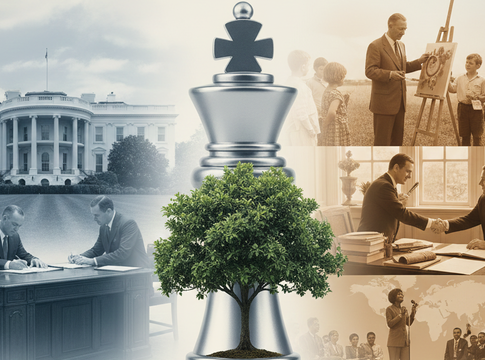
The American presidency is arguably the most powerful office in the world, but once the four or eight years are complete, the Chief Executive becomes a citizen once more. The U.S. Constitution does not prescribe a formal role for former presidents, leaving their subsequent careers to personal ambition, financial necessity, and the changing expectations of the American public.
Examining the post-presidential lives of seven diverse leaders—from the 19th century to the present—reveals an evolving role: from political rehabilitation and literary pursuit to global humanitarianism and modern media production.
1. Andrew Johnson (1865–1869): Political Redemption
Andrew Johnson, who survived impeachment by a single Senate vote, sought to vindicate his presidency through a return to political office. After leaving the White House, he attempted several runs for Congress.
Post-Presidential Activity: Johnson campaigned relentlessly and, in 1875, achieved the singular feat of being elected to the U.S. Senate from Tennessee. Legacy: He remains the only former U.S. President to serve in the Senate. However, his triumph was short-lived; he died just five months into his term.
2. Ulysses S. Grant (1869–1877): Memoir and Legacy
After leaving office and experiencing severe financial misfortune due to poor investments, Ulysses S. Grant embarked on a global tour that restored some of his public prestige. However, his most lasting contribution came from a desperate need for funds while battling terminal cancer.
Post-Presidential Activity: He collaborated with his friend, Mark Twain, to publish his autobiography. Legacy: The Personal Memoirs of U.S. Grant were published shortly after his death and proved to be a critical and commercial success, earning his family a fortune and establishing a reputation as one of the finest literary works written by a former president.
3. Herbert Hoover (1929–1933): Rehabilitation through Service
Herbert Hoover left the presidency associated with the Great Depression and faced widespread public scorn. Rather than retreating, he dedicated the next three decades of his life to public service, eventually restoring his reputation as a capable administrator and humanitarian.
Post-Presidential Activity: Hoover led several major government commissions, including two “Hoover Commissions” tasked with reorganizing and streamlining the executive branch. He also continued his decades-long global humanitarian work. Legacy: His administrative reforms influenced post-World War II government structure, and his later service demonstrated a powerful, decades-long commitment to political rehabilitation.
4. Jimmy Carter (1977–1981): The Humanitarian Model
Jimmy Carter fundamentally redefined the American post-presidency. After a defeat in 1980, he channeled his energy into global diplomacy and human rights advocacy.
Post-Presidential Activity: In 1982, he and his wife Rosalynn established The Carter Center. The organization focuses on conflict resolution, democratic election monitoring, and disease eradication across the globe. Legacy: Carter’s work on combating Guinea worm disease and promoting human rights earned him the Nobel Peace Prize in 2002. He set the modern standard for active, non-political, humanitarian engagement.
5. Bill Clinton (1993–2001): Global Philanthropy and Advocacy
Following his presidency, Bill Clinton leveraged his global network and charisma to become one of the most prominent figures in global philanthropy.
Post-Presidential Activity: He founded the Clinton Foundation, focusing on large-scale global health and development challenges, including HIV/AIDS treatment and climate change. He also became a highly sought-after public speaker and author. Legacy: The foundation has executed major public health initiatives and fostered partnerships between governments and NGOs worldwide, establishing him as a powerful force in international development.
6. George W. Bush (2001–2009): Art and Reflection
After two terms dominated by foreign wars and the September 11 attacks, George W. Bush retreated from public political commentary, choosing instead to pursue personal and philanthropic interests.
Post-Presidential Activity: He dedicated himself to painting, focusing primarily on portraits of world leaders and, later, American veterans. He also engaged in veterans’ advocacy through the Bush Center. Legacy: His decision to focus on creative expression and quiet support for veterans was seen as a way to craft a more personal and introspective legacy following his highly polarized time in office.
7. Barack Obama (2009–2017): Civic Leadership and Media
Barack Obama has embraced the platform provided by the modern digital age, blending civic engagement, high-level commentary, and mass media production.
Post-Presidential Activity: He established the Obama Foundation to focus on global leadership training and civic engagement. He and his wife Michelle also launched a successful media production company, Higher Ground, which produces content for major streaming services. Legacy: Obama’s second act emphasizes shaping future leaders, utilizing mass media to disseminate ideas, and continuing to influence public discourse from a position outside traditional politics.
The trajectory of these seven presidents confirms that the post-presidency has evolved from a period of quiet retirement to an influential platform for continued public service, reflecting the immense power and visibility that the office now confers upon its occupants.
Good Grief, History may be written by the victors, but you can count on the media to regurgitate the lies. Let’s stop regaling post presidencies for Clinton and his humanitarian theft foundation, ask the Haiti’s where their billions went. Let’s not pretend Obama was still running the white house during Biden’s geriatric stint. He was a “weekend at Bernie’s” president. Lastly, their legacy was selling out America to the globalists, red carpeting the immigrants, the debt load, the decline in every measurable standing, destroyed educational system, and 100 years of social issues above American taxpayers.