

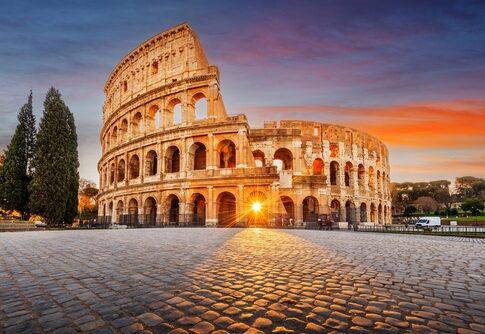
The Roman Colosseum is not just an architectural marvel; it was a deadly arena where gladiators fought to the death for public entertainment. These spectacles weren’t mere displays of bravery; they were intricately designed to manipulate public perception and maintain control over the masses. The grandeur of the Coliseum served as a distraction from the political instability that plagued Rome, masking the empire’s internal chaos with the roar of the crowd and the clash of steel.
The Political Context of Brutality
Imagine the scene: tens of thousands of spectators gathered within the massive stone structure, their voices merging into a deafening roar as gladiators faced off in bloody combat. The Colosseum, with its complex network of trap doors and underground passages, was a well-oiled machine of death, operated with precision to ensure maximum spectacle. Yet, beneath the surface, these events were deeply rooted in political strategy, designed to keep the populace entertained and away from thoughts of rebellion.
The construction of the Colosseum began in AD 70 during a tumultuous period in Roman history. The empire was in turmoil following the rapid succession of three emperors—Galba, Otho, and Vitellius—all of whom failed to stabilize the political landscape. In this context, Emperor Vespasian commissioned the Colosseum as a means to restore public order and consolidate power. The massive amphitheater was not only a feat of engineering but also a tool of political propaganda, designed to project the strength and stability of the Roman state.
However, the continuous cycle of violence and spectacle within the Colosseum may have contributed to the eventual decline of the empire. As the video suggests, the relentless pursuit of entertainment and distraction led to a cultural decay that weakened the Roman society from within. The focus on blood sports as a means of control reflected deeper issues within the empire, highlighting the unsustainable nature of a society obsessed with power and domination.
The Legacy of the Coliseum
Today, the Colosseum stands as a symbol of Rome’s imperial might and its darker history. Its architectural brilliance is admired by millions of tourists each year, a testament to Rome’s engineering prowess and its complex past. Yet, the echoes of the gladiatorial games linger, reminding us of the brutal cost of entertainment and the lengths to which rulers will go to maintain their grip on power.
The video leaves us pondering the true impact of these deadly games on the Roman Empire. Were they simply a distraction, or did they play a significant role in the empire’s downfall? The answer may lie in the balance between spectacle and society, a delicate equilibrium that, when tipped, can lead to the unraveling of even the mightiest of empires.