

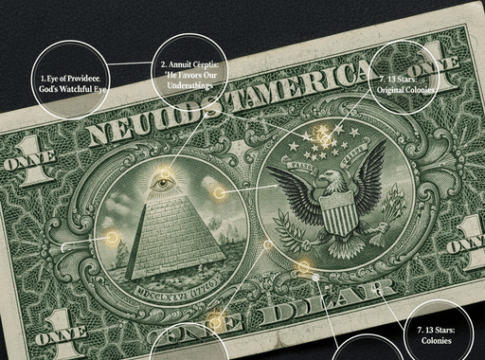
The U.S. one-dollar bill is more than just currency; it is a meticulously crafted document of American history and founding philosophy. Every element, from the portrait of George Washington (first added in 1869) to the intricate seals, was chosen to convey messages about unity, divine providence, and the nation’s ongoing journey.
The most profound symbols are derived from the Great Seal of the United States, finalized in 1782 by Charles Thomson and drawn from the proposals of committees including Franklin, Jefferson, and Adams. The seal’s reverse side (the pyramid) was first printed on the dollar bill in 1935, ensuring that the currency carried this fundamental patriotic imagery.
Here is an analysis of seven major symbolic elements found on the $1 bill.
The Reverse Side: The Great Seal (Pyramid and Eye)
The left side of the dollar bill features the reverse side of the Great Seal, dominated by the unfinished pyramid and the Eye of Providence.
1. The Unfinished Pyramid and MDCCLXXVI
The thirteen layers of the pyramid symbolize the original thirteen colonies. Crucially, the pyramid is unfinished, signifying the founders’ belief that the nation’s work was not yet complete and that the country would continue to grow and progress. At the base of the pyramid, the Roman numerals MDCCLXXVI stand for 1776, the year the Declaration of Independence was signed—the official birth of the new nation.
2. The All-Seeing Eye (Eye of Providence)
Hovering above the pyramid is the Eye of Providence, often referred to as the All-Seeing Eye. Contrary to popular conspiracy theories, this symbol was adopted by the founders as a sign of divine providence—the belief that God favored and was watching over the new nation’s venture. It reflects the deeply held spiritual convictions of many 18th-century Enlightenment thinkers.
3. Annuit Coeptis
The Latin phrase written in the scroll above the Eye is Annuit Coeptis, which translates to: “He [God] has favored our undertakings.” This motto directly reinforces the idea that the success of the American experiment was due, in part, to divine approval.
4. Novus Ordo Seclorum
Below the pyramid, the banner bears the inscription Novus Ordo Seclorum, meaning: “New Order of the Ages.” This phrase speaks to the founders’ revolutionary belief that they were establishing a uniquely new form of government based on liberty and republican ideals, marking a distinct break from the old European monarchical systems.
The Obverse Side: The Great Seal (Eagle and Shield)
The right side of the dollar bill features the obverse of the Great Seal, the main side used by the U.S. government to stamp official documents. This side is dominated by the Bald Eagle.
5. The Bald Eagle, Olive Branch, and Arrows
The Bald Eagle is the national bird of the United States, symbolizing strength and independence. The eagle holds two important symbols in its talons:
- In its right talon, the olive branch, symbolizing the founders’ desire for peace.
- In its left talon, a bundle of thirteen arrows, symbolizing the nation’s power to wage war and defend itself.
The eagle’s head is turned toward the olive branch, indicating the nation’s preference for peace over war.
6. The Shield
The eagle’s chest is protected by a shield, which has thirteen vertical stripes (representing the original states) joined by a horizontal bar above. This design represents the union of the states, supported by Congress and protected from above. It has no support on its sides, symbolizing the need for the states to stand on their own and rely on their collective strength.
7. E Pluribus Unum
Held in the eagle’s beak is a scroll bearing the motto E Pluribus Unum, meaning “Out of Many, One.” This is perhaps the most fundamental symbolic statement of the nation, emphasizing the union forged from the thirteen separate states and the diverse people who constitute the American society.
Other Essential Symbols
The final major symbolic element is the Treasury Seal, located on the left side of the bill, containing a key, scales, and the number 13. The scales represent justice, and the key represents official authority and protection of the Treasury.
Together, these symbols—from the aspirations carved into the pyramid to the declaration of unity in the eagle’s scroll—encapsulate the historical journey and foundational values of the United States.
As long as it pays for my needs that is what matters, if the one dollar bill is still around and not removed like the penny was by next term!